Bedtime stories · free, to read aloud
Three bedtime stories to read tonight
Here are three complete stories, free and without signing up. One for two-year-olds, one for four-year-olds, one for six-year-olds. We wrote them ourselves, and you can read them aloud as often as you like.
Further down: three story openings to finish with your child, three well-loved bedtime books with their age ratings, free places to find the next book, and what's really known about bedtime routines.
3 stories to read aloud10 min read for the whole page9 sources
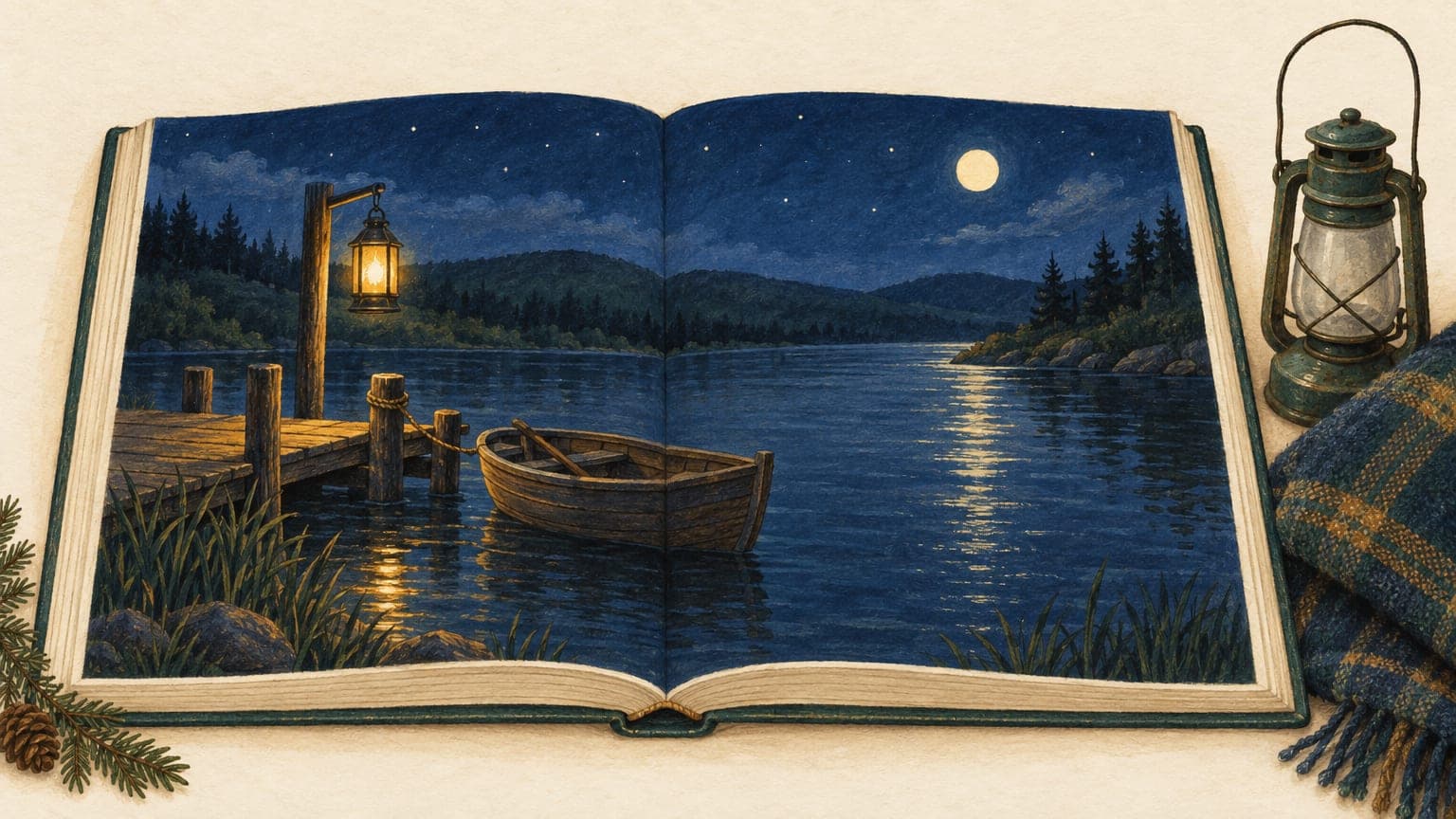
Everything that's already asleep
from 22 min read aloudEverything that has fallen asleep, one after another, until only one is still awake.
The digger is asleep.
It's standing on the building site with its bucket down in the sand, and it isn't moving any more.
The dog is asleep.
He's lying by the door with a paw over his nose, dreaming of the garden gate.
The blackbird is asleep.
She's in the lilac bush, round and still, with her head tucked into her feathers.
The bike is asleep.
It's leaning against the wall. The bell has nothing more to say.
The bus is asleep.
It's in the depot with all its doors shut and all its lights off.
The cloud is asleep.
It's up above the roof, and it hardly moves at all.
And in the house, in the room, in the bed, under the blanket, on the pillow, with your teddy in your arms,
you'll be asleep soon too.
Goodnight, digger. Goodnight, dog. Goodnight, blackbird, bike, bus and cloud.
Goodnight, you.
The moon and the forgotten hat
from 44 min read aloudThe moon finds a hat and looks for its owner, but all the animals are already asleep.
As she passed over the rooftops, the moon found a hat. It was red, it was small, and it was lying in the middle of a slate roof, as if someone had forgotten it there.
“This must belong to somebody,” said the moon. “I'll take it back to them.”
She went to the fox, who lives at the edge of the wood.
“Fox, is this your hat?”
But the fox was curled up in his den with his tail over his nose, sleeping so deeply that not even an ear twitched.
She went to the owl, who never sleeps.
“Owl, is this your hat?”
But the owl was sitting on her branch with her eyes shut, making a little noise that sounded a bit like a snore.
She went to the ducks on the pond. She went to the cat on the wall. She went to the old horse in his field. Everyone was asleep. The moon moved more and more slowly, so as not to wake anybody.
In the end she was tired, and she still had the hat.
Then she saw a window that was still lit. Just one, in the whole village. Behind it, a child was sitting up in bed, still awake.
The moon put the hat down on the windowsill.
“Maybe it's yours,” she said. “And if it isn't, you can look after it for now.”
The child took the hat, put it next to the pillow and switched off the light.
The moon went on her way over the rooftops. Now, at last, the whole village was asleep.
The night ferry
from 67 min read aloudA ferryman carries the wind, the noise and the whole day to the other bank. A child asks if they can come too.
Down by the river there's a boat that does nothing all day. Only when it gets dark does the ferryman come, untie the rope and push the boat out onto the water with his long pole.
He doesn't carry people. He carries whatever is tired.
First comes the wind. It has tugged at flags and chased leaves down the streets all day, and now it's so worn out it barely ruffles the water. The ferryman helps it aboard. The wind lies down on the bench and says nothing more.
Next comes the noise. On loud days it's especially heavy: the building site, the car horns, the shouting in the school yard, all at once. The ferryman has to try three times to heave it over the side.
Then comes the day itself. It sits right at the back, holds its bag close and looks back at the bank it came from.
The ferryman pushes off. The water makes only a small sound, like someone breathing very slowly.
On the other bank, everyone gets out. The wind, the noise, the day. They climb a hill and disappear over the top, and then, on the other side, everything is quiet.
When the ferryman comes back, a child is waiting on the jetty.
“Can I come too?”
The ferryman shakes his head. “Not that way. You'll cross tomorrow morning, in the other direction.”
“And what do I do until then?”
“You do what the river does,” says the ferryman. “The river never goes anywhere. It just stays where it is and waits for the morning.”
The child looks at the water. It's true: the river just stays where it is.
“I can do that,” says the child.
“Everyone can,” says the ferryman. “You only have to let go.”
He ties up the boat, hangs the lantern on its hook and goes home. The child goes home too, climbs the stairs, goes into their room and slips into bed.
Outside, the river stays where it is and waits for the morning. Inside, the child lies still and does exactly the same.
Three openings to finish together
For the evenings when reading isn't enough and your child wants to tell the story. Read just the opening, then ask: and then what? If the story stalls, a question gets it going again better than a ready-made idea.
The key in the snow
There's a key in the snow outside the front door. It doesn't open any door in the house.
The light in the shed
In the garden shed, where nobody has been for years, a light has come on every evening since yesterday.
The suitcase in the wood
In the middle of the wood there's a suitcase. It isn't old, it isn't wet, and it isn't locked.
What makes a bedtime story different from other stories
First, so you know where this comes from: there is no research on the ideal length of a story for falling asleep, on open endings or on how to build suspense. We looked and found nothing that deserves the name. What follows comes from our own experience of writing; no study confirms it.
The energy goes down. An ordinary story climbs towards a high point. A bedtime story does the opposite: it starts in movement and ends in stillness. That's why the third story ends with a river that simply stays where it is.
The world gets smaller. From outside to inside, from the village to the house, from the house to the bed. A bedtime story closes the space in, step by step.
Repetition is a strength. Little ones love hearing the same phrase twenty times, and the steady rhythm does what a lullaby does. In the first story, the same pattern comes back a dozen times, on purpose.
The ending has to arrive. Suspense doesn't help before sleep: a child who wants to know what happens next keeps thinking.
The child gets something to do. It's the trick that works most reliably, and the one you notice least. A child who can't settle doesn't know what to do with an instruction. A picture helps more: lie still like the river, be as quiet as the blackbird in the lilac.
What's known about bedtime routines, and what isn't
Regularity is well supported. A study of more than 10,000 children aged 0 to 5 found a link between a regular bedtime routine and better sleep, and the link is graded: the more regular the routine, the faster children fall asleep, the less often they wake at night and the longer they sleep.
Health services describe the same routine. The NHS recommends a regular bedtime routine and notes that waking in the night is normal, in babies and older children alike. The American Academy of Pediatrics sums up its evening routine in three words: “Brush, Book, Bed”, meaning teeth, a book and a fixed bedtime.
It isn't established that reading works better than anything else. No solid study compares reading aloud with cuddles, singing or stroking and finds an advantage for sleep. What seems to matter is that the routine happens the same way every evening. Reading at night has other good reasons, well supported for language; for falling asleep itself, no advantage has been shown.
How much sleep? The American Academy of Pediatrics gives, per day: 11 to 14 hours between one and two years, 10 to 13 hours between three and five, 9 to 12 hours between six and twelve.
And screens before bed? The Sleep Foundation notes that children's eyes let in more light than adults' eyes do, and that blue light holds back melatonin more. It adds in the same text that most studies on this are observational and don't prove a cause: we don't know whether screens disturb sleep or whether children who sleep badly use them more. A team at the University of Colorado Boulder also stresses how sensitive children are to evening light.
Three books to take over
The age ratings come from Common Sense Media and BookTrust, checked on 26 September 2026; the source is under each book. None of these books is ours.
Goodnight Moon
Margaret Wise Brown, illustrations: Clement Hurd · Harper & Brothers 1947 · age 2+
A little bunny says goodnight to everything in the great green room, one thing at a time. The same slowing-down that our first story uses, in a book that has been doing it since 1947.
Source: Common Sense Media, book review: “age 2+”; publisher and year from en-us-inhalte.md §6.
Guess How Much I Love You
Sam McBratney, illustrations: Anita Jeram · Walker Books 1994 · interest age 0 to 3
Two hares compare how much they love each other, until the smaller one falls asleep. Short enough for the age when a story shouldn't last longer than bedtime itself.
Source: BookTrust Bookfinder: interest age 0 to 3, reading age 0 to 3; Walker Books, first published 1994.
Llama Llama Red Pajama
Anna Dewdney · Viking 2005 · age 3+
A little llama alone in bed, waiting for Mama to come back upstairs. For children who find the minutes after the light goes out the hardest.
Source: Common Sense Media, book review: “age 3+”; Viking, 2005.
Free help to find the next book
Our research found no free bedtime stories to recommend in Ireland, the UK or the US that we could check properly. These four free resources help you find the next book, each with an age for every title. Checked on 26 September 2026.
- BookTrust Bookfinder
The UK reading charity's free book search. Every book has an interest age and a reading age, and you can filter by both.
- Children's Books Ireland
Ireland's national children's books organisation publishes a free reading guide of the year's best Irish books, sorted by age.
- Libraries Ireland: Summer Stars reviews
Reviews of children's books from Ireland's public libraries, with an age band for each book. Borrowing costs nothing.
- Common Sense Media book reviews
A US non-profit that gives every book it reviews a minimum age, from board books to novels.
Frequently asked questions
Can I read the stories on this page freely?
Yes. We wrote them and share them for reading aloud, at home, at nursery, at school or in the library. If you want to reproduce or publish them, please ask us first.
How long should a bedtime story be?
There's no solid research on this, even though a lot of numbers go around. In practice it depends on your child: the first story on this page takes two minutes to read, the third seven. If your child falls asleep halfway through, the story was long enough.
Does a story help children fall asleep better than singing or a cuddle?
We can't say. It's well supported that a fixed routine, the same every evening, improves sleep, and the more regular it is, the better. No study compares reading with other routines and finds an advantage. For language development, reading has good reasons of its own.
What is “Brush, Book, Bed”?
An evening routine recommended by the American Academy of Pediatrics: brushing teeth, then a book, then bed at a fixed time. It fits from the first tooth well into primary school.
How much sleep does a child need?
The American Academy of Pediatrics gives 11 to 14 hours a day between one and two years, 10 to 13 hours between three and five, and 9 to 12 hours between six and twelve, naps included.
Are screens before bed harmful?
Children's eyes let in more light than adults' eyes, and blue light holds back melatonin. The Sleep Foundation itself says that most studies on this don't prove a cause. Leaving screens out before bed costs nothing, but the rule isn't as certain as it's often made to sound.
A story in which your child appears
At Sagalino, the bedtime story is built around your child, with their name and the people they love. You read all of it for free before you decide.
See how it worksSources
- 1.Mindell et al.: Bedtime Routines for Young Children, A Dose-Dependent Association with Sleep Outcomes, Sleep, 2015.What it confirms: More than 10,000 children aged 0 to 5; the more regular the bedtime routine, the better the time to fall asleep, night waking and sleep duration.
- 2.NHS: Sleep and young children.What it confirms: A regular bedtime routine is recommended; waking at night is normal, in babies and in older children.
- 3.American Academy of Pediatrics, HealthyChildren.org: Brush, Book, Bed.What it confirms: The evening routine of brushing teeth, a book and a fixed bedtime.
- 4.American Academy of Pediatrics, HealthyChildren.org: Healthy Sleep Habits.What it confirms: Sleep needs per day: 11 to 14 hours at 1 to 2 years, 10 to 13 at 3 to 5, 9 to 12 at 6 to 12.
- 5.Sleep Foundation: How Blue Light Affects Kids' Sleep.What it confirms: Children's eyes let in more light than adults'; most studies are observational and don't prove a cause.
- 6.University of Colorado Boulder: Kids uniquely vulnerable to sleep disruption from electronics.What it confirms: Children's particular sensitivity to evening light.
- 7.Common Sense Media: Goodnight Moon, book review.What it confirms: The rating “age 2+”.
- 8.BookTrust Bookfinder: Guess How Much I Love You.What it confirms: Interest age 0 to 3, reading age 0 to 3; Walker Books.
- 9.Common Sense Media: Llama Llama Red Pajama, book review.What it confirms: The rating “age 3+”.
Sources accessed on 26 September 2026. We wrote the stories on this page ourselves, and you can read them aloud as often as you like.