History of the children's book · from 1901 to today
The history of children's books
This timeline follows the children's book in Britain, Ireland and the United States, from Beatrix Potter's privately printed rabbit in 1901 to a new Gruffalo story in 2026: the books, the prizes and the people that made a difference.
Every date carries a source number, and where the sources run out, we say so. On a subject where dates get copied from book to book, that seemed more important to us than being complete.
12 min read31 sources · accessed on 26 September 2026
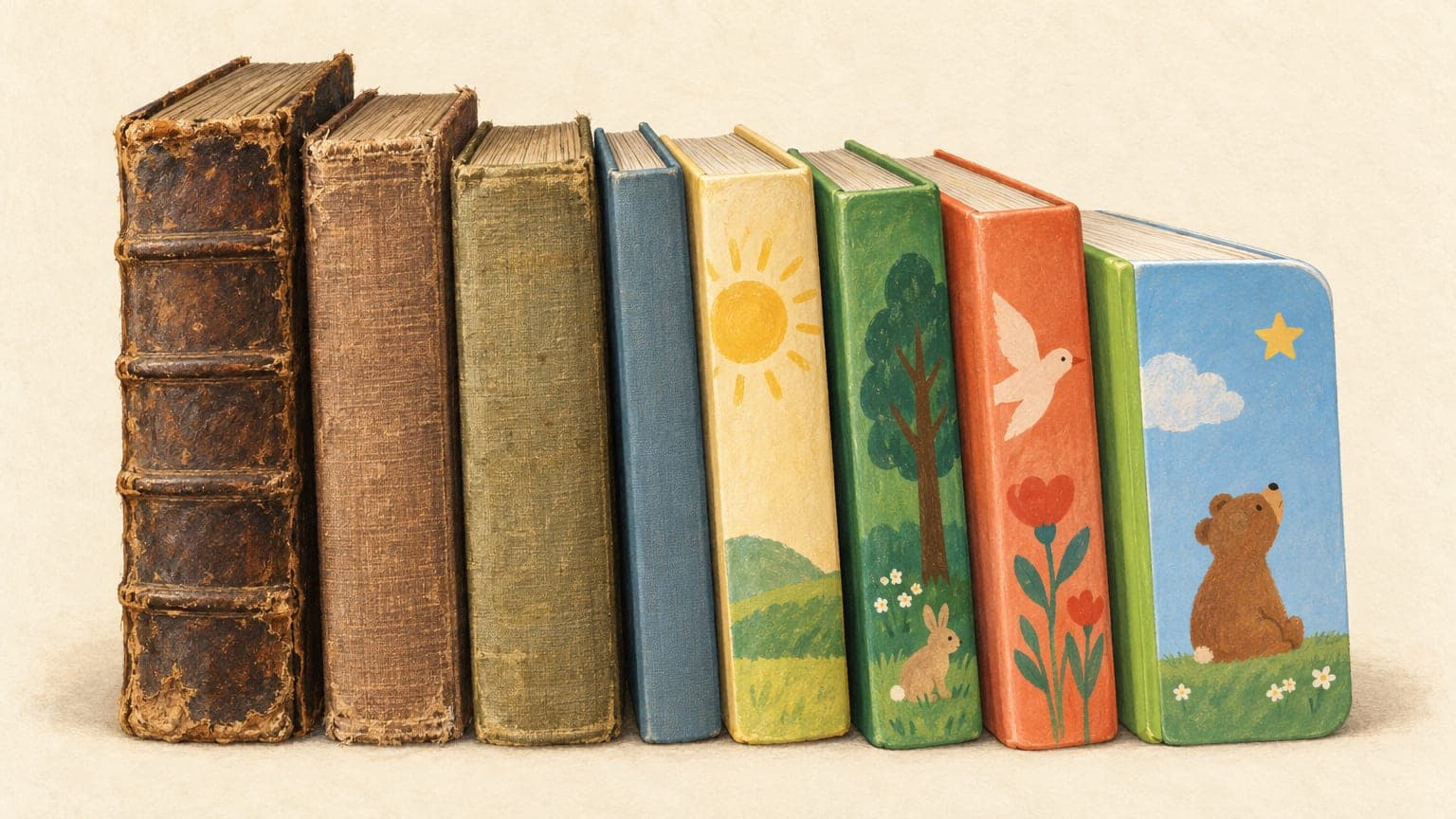
Four figures to set the scene
A little over a century of picture books. These figures mark some of its stages.
250
copies of The Tale of Peter Rabbit that Beatrix Potter had printed at her own expense in 1901.1
Victoria and Albert Museum
1936
the year the Carnegie Medal was founded, in memory of Andrew Carnegie.5
Yoto Carnegies
55m+
copies of The Very Hungry Caterpillar sold worldwide, in 70 languages.11
Penguin
13m+
copies of The Gruffalo sold since 1999.16
National Literacy Trust
The Rainbow Fish, a Swiss picture book published in 1992, has sold more than 30 million copies and exists in 50 languages.14
1901 to 1926
Animals in jackets, and a bear of very little brain
In 1901, Beatrix Potter had 250 copies of The Tale of Peter Rabbit printed at her own expense, because no publisher wanted it. A year later, Frederick Warne published it.1 BookTrust still recommends it today, with an interest age of 3 to 6.2
In 1926, Methuen published A. A. Milne's Winnie-the-Pooh.3 BookTrust gives it an interest age of 4+ and a reading age of 7+: a book to be read aloud long before a child reads it alone.3
The dates of this era
What remains today
Potter's watercolours still shape what many people picture when they think of a children's book.
1936 to 1958
Medals, a great green room and a bear from Peru
In 1936, the Carnegie Medal was founded in Britain, in memory of Andrew Carnegie. An award for illustration followed in 1955, for a long time called the Kate Greenaway Medal.56
In 1947, Harper & Brothers published Goodnight Moon by Margaret Wise Brown, illustrated by Clement Hurd. It never won the Caldecott Medal, contrary to a widespread belief. Anne Carroll Moore, the influential children's librarian of the New York Public Library, rejected it, and the library didn't add it to its catalogue until 1972.7
In 1958, William Collins published Michael Bond's A Bear Called Paddington.4
1963 to 1974
Wild things, a tiger at tea and a hungry caterpillar
In 1963, Maurice Sendak's Where the Wild Things Are appeared in the United States. It won the Caldecott Medal in 1964, and BookTrust recommends it in Britain.8
In 1968, two books arrived that British children still grow up with: Judith Kerr's The Tiger Who Came to Tea, published by William Collins10, and David McKee's Elmer, first published by Dobson Books and newly illustrated at Andersen Press from 1989.9
In 1969 came Eric Carle's The Very Hungry Caterpillar. It has since sold more than 55 million copies worldwide and been translated into 70 languages.11
In 1974, Jill Murphy's The Worst Witch began a school story for young readers; BookTrust gives it an interest age of 6+.12
1990 to 1999
Irish awards, a naughty boy and a boy wizard
From 1990, Ireland had its own children's book awards, first as the Bisto Book of the Year, later the CBI Book of the Year and today the KPMG Children's Books Ireland Awards. They are open to authors and illustrators born or living in Ireland, and books in English or Irish.13
In 1994, Orion published Francesca Simon's first Horrid Henry, illustrated by Tony Ross15, and Walker Books published Sam McBratney and Anita Jeram's Guess How Much I Love You.17
On 26 June 1997, Bloomsbury published Harry Potter and the Philosopher's Stone in Britain.18 In 1999, Macmillan published Julia Donaldson and Axel Scheffler's The Gruffalo.16
2003 to 2013
Translations, series and a Children's Laureate
Books from other languages found British readers in their own way. In 2003, Chicken House published Cornelia Funke's Inkheart in Anthea Bell's translation.19 In 2007, the small Hawthorn Press brought out Pancakes for Findus, keeping the Swedish names Pettson and Findus; the American edition calls the pair Festus and Mercury.20
In 2005, HarperCollins published Lost and Found by Oliver Jeffers, who was born in Belfast.21 In 2007, Amulet Books published the first Diary of a Wimpy Kid in the United States; in Britain, the series is published by Puffin.2223
Julia Donaldson was Children's Laureate from 2011 to 2013.24 In 2011, Scholastic published Liz Pichon's The Brilliant World of Tom Gates.25
Today
New stories, new names, more Irish
The two Carnegie awards now go by the name Yoto Carnegies. They are run by CILIP, the library and information association, with BookTrust involved in the nominations.5
On 10 September 2026, Macmillan published a new Gruffalo story, Gruffalo Granny. BookTrust sends 40,000 copies to libraries as part of its Storytime programme.26
In Ireland, more children learn in Irish than ever: in 2023 there were 188 Gaelscoileanna at primary level outside the Gaeltacht, with over 40,000 pupils. Fifty years earlier there were ten.27
Three questions the sources don't settle
Some dates and details are copied so often that nobody checks them any more. These three we couldn't settle.
When did We're Going on a Bear Hunt first appear?
What we know
The book is by Michael Rosen and Helen Oxenbury, published by Walker Books, and BookTrust recommends it with an interest age of 2+.28
What remains open
The only first-publication date our research found comes from an antiquarian bookseller and gives Christmas Day 1989, an unusual date for a book launch. We therefore don't give a date on this page.
What was Momo called in Britain?
What we know
Michael Ende's Momo is published in Britain by Puffin in J. Maxwell Brownjohn's translation, and an earlier British edition appeared as The Grey Gentlemen.29
What remains open
When that earlier edition appeared, and why the title changed, is not in our sources.
Who counts as an Irish children's author?
What we know
The KPMG Children's Books Ireland Awards take authors and illustrators who were born or live in Ireland, and books in English or Irish.13 Oliver Jeffers, born in Belfast, is one example.21
What remains open
For writers born in Northern Ireland or living abroad, whether a book is “Irish” depends on who is asking. The awards give one answer; readers and booksellers may give another.
Where the experts disagree
Two questions that come up whenever people talk about classics.
Is The Little Prince a children's book?
By its readers
By its publisher
Penguin also publishes it as a Penguin Modern Classic, and its product page gives no children's age at all.30
Is a classic made by prizes or by readers?
Prizes as the measure
Readers as the measure
Goodnight Moon never won the Caldecott, and the New York Public Library kept it out of its catalogue until 1972.7 Readers kept it anyway.
Frequently asked questions
What is the oldest picture book still read to children today?
Among the books on this timeline, The Tale of Peter Rabbit: Beatrix Potter had 250 copies printed at her own expense in 1901, and Frederick Warne published it in 1902. BookTrust still recommends it, with an interest age of 3 to 6.
What is the Carnegie Medal?
Britain's best-known children's book award, founded in 1936 in memory of Andrew Carnegie. An award for illustration, for a long time called the Kate Greenaway Medal, followed in 1955. Today both go by the name Yoto Carnegies and are run by CILIP.
Did Goodnight Moon win the Caldecott Medal?
No, contrary to a widespread belief. Anne Carroll Moore, the influential children's librarian of the New York Public Library, rejected the book, and the library only added it to its catalogue in 1972.
When was The Gruffalo published?
In 1999, by Macmillan. It has sold more than 13 million copies. A new story, Gruffalo Granny, came out on 10 September 2026, and BookTrust is sending 40,000 copies to libraries.
What are the Irish children's book awards?
The KPMG Children's Books Ireland Awards, which began in 1990 as the Bisto Book of the Year. They're open to authors and illustrators born or living in Ireland, for books in English or Irish.
A story that belongs to your child
At Sagalino, a story of its own is built around your child, with their name, in one of our illustration styles. You read all of it for free before you decide.
See how it worksSources
- 1.Victoria and Albert Museum: Peter Rabbit, the tale of The Tale.What it confirms: In 1901, 250 privately printed copies; in 1902, Frederick Warne's edition.
- 2.BookTrust Bookfinder: The Tale of Peter Rabbit.What it confirms: Interest age 3 to 6, reading age 5 to 7; Frederick Warne.
- 3.BookTrust Bookfinder: Winnie-the-Pooh.What it confirms: Methuen, 1926; interest age 4+, reading age 7+.
- 4.BookTrust Bookfinder: A Bear Called Paddington.What it confirms: First published by William Collins in 1958; interest age 6 to 8, reading age 7+.
- 5.Yoto Carnegies: nominations announced, 2024.What it confirms: The Carnegie Medal, founded in 1936 in memory of Andrew Carnegie; today's name Yoto Carnegies; run by CILIP with BookTrust involved in the nominations.
- 6.Wikipedia: Carnegie Medal for Illustration.What it confirms: The award for illustration since 1955, formerly the Kate Greenaway Medal.
- 7.New York Public Library: Goodnight Moon and Margaret Wise Brown, 30 September 2022.What it confirms: Goodnight Moon, Harper & Brothers, 1947; never a Caldecott winner; rejected by Anne Carroll Moore and not in the NYPL catalogue until 1972.
- 8.BookTrust Bookfinder: Where the Wild Things Are.What it confirms: BookTrust's recommendation; the Caldecott Medal of 1964.
- 9.BookTrust Bookfinder: Elmer.What it confirms: First published by Dobson Books in 1968, newly illustrated at Andersen Press from 1989; interest age 2 to 5.
- 10.BookTrust: The Tiger Who Came to Tea.What it confirms: First published in 1968; interest age 2+, reading age 6+.
- 11.Penguin: The Very Hungry Caterpillar.What it confirms: Translated into 70 languages, more than 55 million copies sold worldwide.
- 12.BookTrust Bookfinder: The Worst Witch.What it confirms: First published in 1974; interest age 6+, reading age 7+.
- 13.Children's Books Ireland: KPMG Children's Books Ireland Awards.What it confirms: Awards since 1990, formerly the Bisto and the CBI Book of the Year, open to authors and illustrators born or living in Ireland, for books in English or Irish.
- 14.Wikipedia: The Rainbow Fish.What it confirms: Published in 1992 by NordSüd Verlag; more than 30 million copies sold; available in 50 languages.
- 15.BookTrust Bookfinder: Horrid Henry.What it confirms: First published by Orion in 1994; interest age 4+, reading age 6+.
- 16.National Literacy Trust: The Gruffalo.What it confirms: The Gruffalo, Macmillan, 1999; more than 13 million copies sold.
- 17.BookTrust Bookfinder: Guess How Much I Love You.What it confirms: Walker Books, first published in 1994; interest age 0 to 3.
- 18.Wikipedia: Harry Potter and the Philosopher's Stone.What it confirms: First published in the UK by Bloomsbury on 26 June 1997.
- 19.Wikipedia: Inkheart.What it confirms: The UK edition by Chicken House on 6 June 2003, translated by Anthea Bell.
- 20.Hawthorn Press: Ten years of Findus and Pettson.What it confirms: Pancakes for Findus, 2007; the UK editions keep the Swedish names, the US edition calls them Festus and Mercury.
- 21.HarperCollins Children's Books: Lost and Found, Oliver Jeffers.What it confirms: Lost and Found by Oliver Jeffers, HarperCollins, first published in 2005.
- 22.Common Sense Media: Diary of a Wimpy Kid, Book 1, book review.What it confirms: The first book of the series, published in the US in 2007.
- 23.Penguin Shop: Diary of a Wimpy Kid.What it confirms: The UK edition from Puffin.
- 24.Wikipedia: Julia Donaldson.What it confirms: Children's Laureate from 2011 to 2013.
- 25.BookTrust Bookfinder: The Brilliant World of Tom Gates.What it confirms: Scholastic, 2011; interest age 9 to 11.
- 26.BookTrust: BookTrust and Macmillan Children's Books bring Gruffalo Granny to libraries across the country.What it confirms: Gruffalo Granny, Macmillan, 10 September 2026; 40,000 copies to libraries through BookTrust's Storytime programme.
- 27.Gaelscoileanna: Irish-medium education, facts and figures.What it confirms: 188 Gaelscoileanna at primary level with over 40,000 pupils in September 2023; ten such schools fifty years earlier.
- 28.BookTrust Bookfinder: We're Going on a Bear Hunt.What it confirms: Michael Rosen and Helen Oxenbury, Walker Books; interest age 2+, reading age 6+.
- 29.Waterstones: Momo, Michael Ende.What it confirms: The British Puffin edition in J. Maxwell Brownjohn's translation; an earlier British edition titled The Grey Gentlemen.
- 30.Penguin: The Little Prince, Antoine de Saint-Exupéry.What it confirms: Parallel editions in Penguin Modern Classics and Puffin Clothbound Classics, with no children's age given.
- 31.St Paul's School: The Little Prince.What it confirms: The Little Prince on the reading list of a London school.
Sources accessed on 26 September 2026. Is something missing or out of date? Write to us and we'll correct it, with the date.