Illustration style
A watercolour children's book
A colour you can see the paper through. No other style can be so quiet, and hardly any has shaped the picture book for so long.
Read the whole story for freeThe same style throughout the bookeBook £4.50
How watercolour came into the picture book
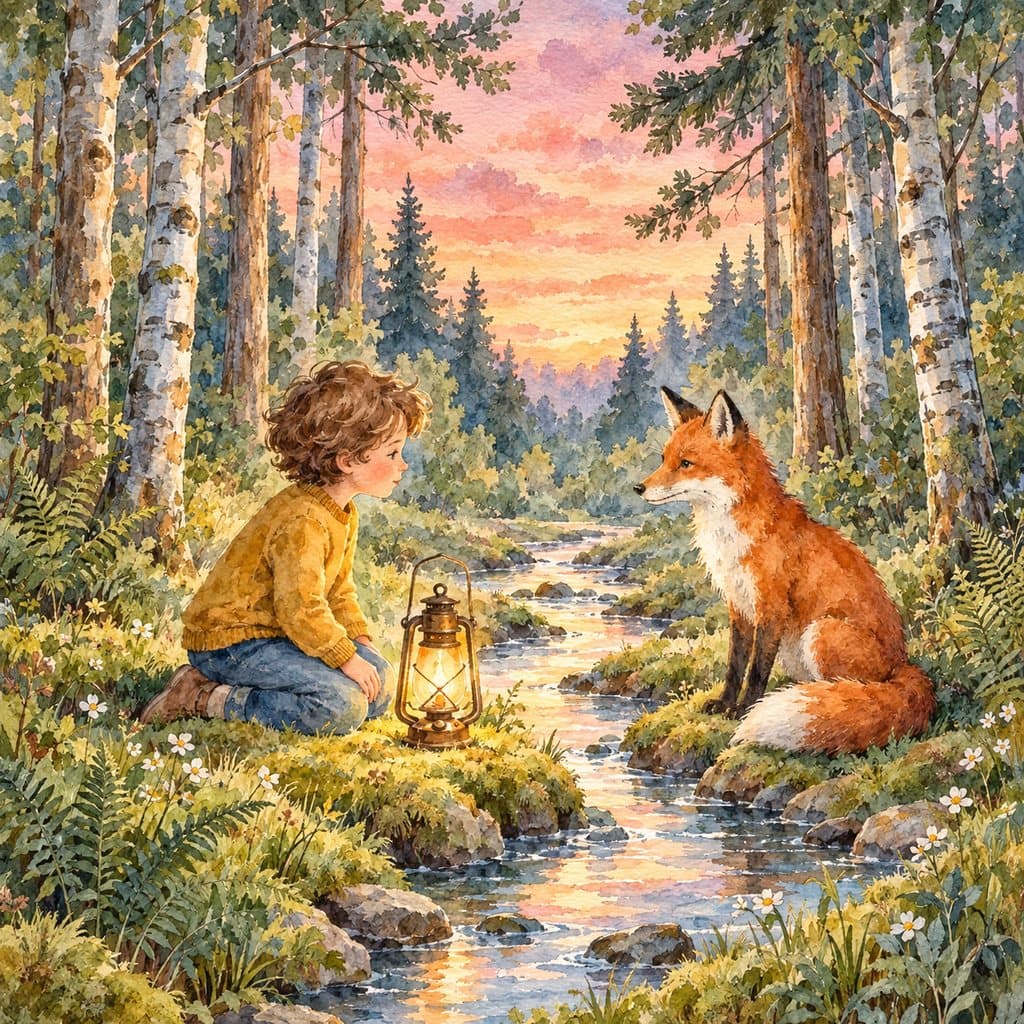
Watercolour is pigment thinned with plenty of water and laid down in transparent layers: the white of the paper shows through the colour. White isn't painted, it's left free. That's where the lightness we associate with children's books comes from.
The technique entered the picture book around 1900, in several places at once. In 1901, Beatrix Potter had 250 copies of The Tale of Peter Rabbit printed at her own expense, because no publisher wanted it. A year later, Frederick Warne published it. Potter had trained in natural history drawing, and it shows: her animals are observed with anatomical precision, and yet they wear jackets.
In Sweden, Elsa Beskow published books from 1897 that introduced children to plants and the seasons. In Switzerland, Ernst Kreidolf brought out Blumen-Märchen (“flower fairy tales”) in 1898, one of the very first picture books illustrated throughout with artistic ambition.
The modern line runs through Lisbeth Zwerger, who received the Hans Christian Andersen Medal for illustration in 1990, the youngest winner up to then. Her watercolours leave a lot of empty space, rare in children's books, and that is what gives them their particular calm.
The names behind it
Beatrix Potter
The Tale of Peter Rabbit, first privately printed, 1901
250 copies paid for herself when no publisher would take it, then Frederick Warne's edition a year later. Her training in natural history drawing shows in every animal.
Ernst Kreidolf
Blumen-Märchen, 1898
One of the first German-language picture books illustrated throughout with artistic ambition. Kreidolf gives plants faces without ever making them silly.
Elsa Beskow
Picture books about plants and the seasons, Sweden, 1897
She shaped the Scandinavian picture-book tradition. Her books explain nature without lecturing.
Lisbeth Zwerger
Hans Christian Andersen Medal for illustration, 1990
The youngest winner up to then. She works with large empty spaces, and the picture book took watercolour seriously again.
How do you recognise watercolour?
- The white in the picture is the paper's: highlights are left free, never added.
- The colours overlap transparently, so you see the lower layer through the upper one.
- Soft edges where it was painted onto wet paper, crisp edges where the colour could dry.
- Often a fine pencil or pen drawing stays visible underneath.
- No perfectly even area of colour: the surface lives from its variations.
Which stories watercolour suits
Watercolour is the style that goes with almost everything, and the safest choice when you're unsure. It carries quiet stories especially well: nature, animals, the seasons, bedtime, goodbyes, everything that does without noisy pictures.
It can also do faces. Because a fine drawing can stay under the colour, likeness and delicate expressions work better here than in any flat-colour style.
It suits stories that live from speed and noise less well. A chase works better in ligne claire.
In terms of age, watercolour suits children from about two until well into primary school.
Good to know
Will my child be recognisable in watercolour?
It's the style best suited to it. A fine drawing can stay under the colour and carry the features, the hairstyle and the expressions. You describe the hair colour, eyes, glasses and favourite outfit; no photo is needed.
From what age does the watercolour style suit?
From about two until well into primary school. It's the style that covers the widest age range, because it looks neither too childish nor too serious.
Isn't watercolour too pale for little ones?
It depends on the amount of water. We work with strong washes and clear contrasts, so the main character can be spotted straight away on every page.
Does the style stay the same throughout the book?
Yes. All 14 double pages are illustrated in the style you choose, and so are the cover and the character's portrait.
- 1.Victoria and Albert Museum: Peter Rabbit, the tale of The Tale.What it confirms: In 1901, first 250 privately printed copies; in 1902, Frederick Warne's edition.
- 2.Ernst Kreidolf, overview of his work. (in German)What it confirms: Blumen-Märchen, 1898, one of the first picture books illustrated with artistic ambition.
- 3.Elsa Beskow, overview of her work. (in German)What it confirms: First picture books from 1897, which shaped the Swedish picture-book tradition.
- 4.IBBY: Hans Christian Andersen Awards, winners.What it confirms: Lisbeth Zwerger received the Andersen Medal for illustration in 1990.
The other styles
- 3D animation
- Andean textile art
- Art Nouveau
- Chinese ink
- Coloured pencil
- Cordel woodcut
- Fine pen
- Graphic and simple
- Graphic novel
- Ink and watercolour
- Ligne claire
- Minhwa world
- Nordic fairy tale
- Paper collage
- Retro gouache
- Risograph
- Silhouettes
- Tingatinga world
- Ukiyo-e inspired
- Wax crayon
At a glance: all illustration styles, how it works, frequently asked questions, the book without a photo, reading the story before you buy and the AI children's book.