Illustration style
A children's book inspired by Japanese colour woodblock prints
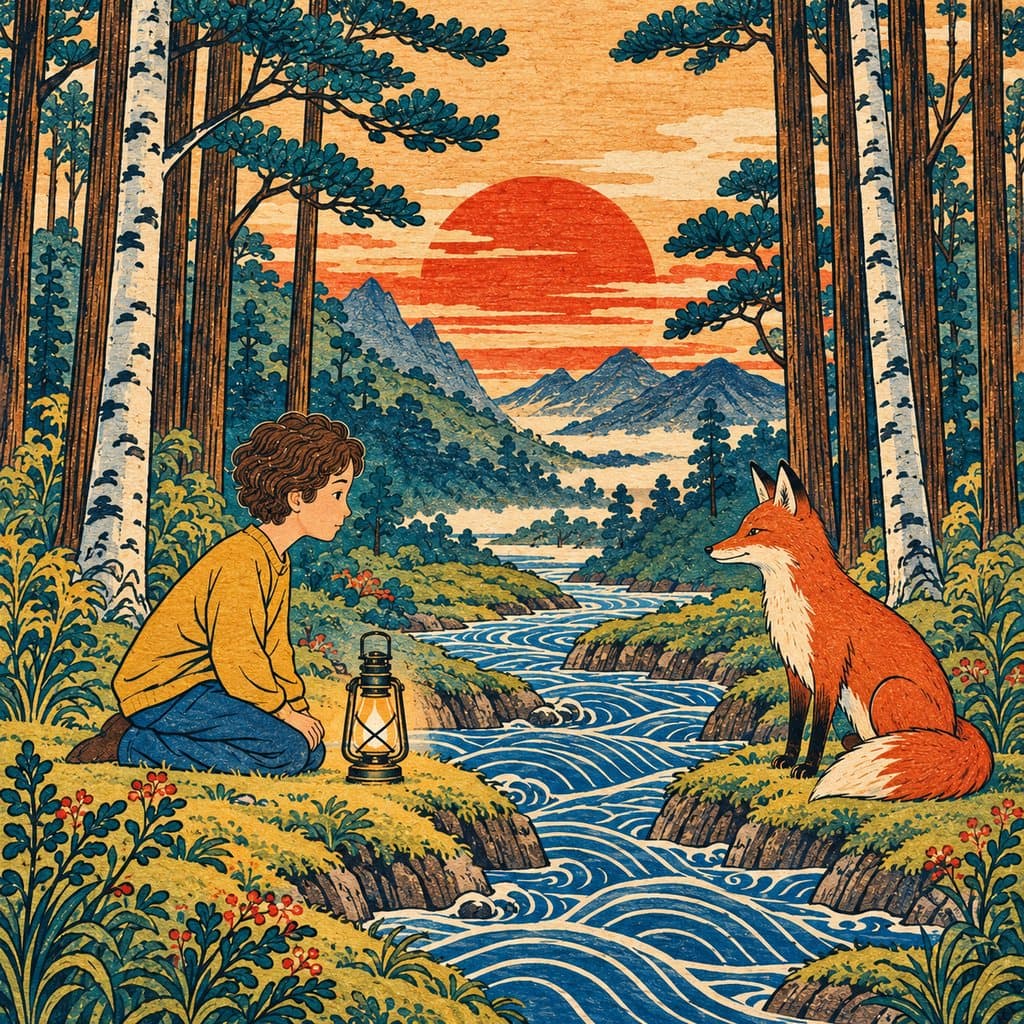
Ukiyo-e means “pictures of the floating world” and names the pictorial tradition of Japanese colour woodblock prints from Edo. Our pictures in this style are present-day children's book illustrations that take their lead from its design: fine outlines, flat colours, layered landscapes and water in rhythmic lines.
Read the whole story for freeThe same style throughout the bookeBook £4.50
Pictures from Edo, made by four pairs of hands
Ukiyo-e arose in the seventeenth century in Edo, today's Tokyo. The city was growing, its merchants had money and leisure, and they wanted pictures of what surrounded them: theatre, fashion, pleasure quarters and, later, landscapes. The woodblock is the printing technique here, ukiyo-e the pictorial tradition that used it over the centuries. Because the pictures were printed, many people could buy the sheets: according to the Asian Art Museum, one set of blocks yielded several thousand impressions.
A classic print was a joint effort. The publisher carried the project: he assessed the market, commissioned the artist, oversaw production and took care of distribution. The artist drew the design in black ink on thin paper. The carver transferred the drawing to a block of cherry wood and cut the wood away around the lines. Last of all, the printer put the colours on the paper. The artist took no part in the printing itself, and some things about the result were only decided in the workshop.
For a multicoloured sheet, a nishiki-e, a separate block was cut for each colour. Small registration marks, kento, held the paper in the same place on every pass so that lines and areas of colour lay exactly on top of one another. According to the Asian Art Museum, an average sheet needed at least about ten impressions. The registration marks became a reliable technique from the middle of the eighteenth century, and Suzuki Harunobu introduced full-colour printing around 1765.
In the nineteenth century, landscape moved to the centre. Katsushika Hokusai had his series Fugaku sanjūrokkei printed in the early 1830s, the Thirty-six Views of Mount Fuji, which later grew to 46 sheets. In it he made extensive use of Prussian blue, a pigment that had reached Japan from Europe only shortly before. Utagawa Hiroshige made the One Hundred Famous Views of Edo. Not only single sheets were printed but also books: ehon, the Japanese word for picture book, means in the narrower sense the woodblock-printed volumes of the Edo period. The Smithsonian Libraries hold over a thousand such volumes, many with pictures by Hokusai and Hiroshige. Hokusai's Hokusai manga comprises fifteen volumes published in Nagoya between 1814 and 1878.
What Sagalino makes of this is a present-day interpretation. Our pictures are made digitally as a single image, not from separate printing blocks printed over one another colour by colour. What we have taken over are the design features of the tradition: dark outlines, calm areas, layered planes, wave lines and a palette from indigo to rust red. Wood grain and paper fibre are imitated as surface texture. That is why the style is called “inspired by ukiyo-e”.
The names behind it
Suzuki Harunobu
First full-colour prints (nishiki-e), 1765
Around 1765 he introduced printing with several colour blocks, replacing the two-colour and three-colour prints.
Katsushika Hokusai
Thirty-six Views of Mount Fuji (Fugaku sanjūrokkei)
His Fuji series, published by Nishimuraya Yohachi in the early 1830s, is among the landscape series through which landscape became the main subject of ukiyo-e in the nineteenth century.
Utagawa Hiroshige
One Hundred Famous Views of Edo (Meisho Edo hyakkei), 1856
With this series he created a landscape and city view of Edo; the Library of Congress shows sheets from it dated 1856.
How do you recognise the ukiyo-e influence in a picture?
- Fine, even dark outlines around almost all shapes, plants, rocks and figures.
- Flat colours without modelling through shadow. Soft gradients appear only in the sky and in the haze of the distance.
- A muted, traditional palette of indigo, rust red, ochre, moss green and cream.
- Water in rhythmic wave lines, with pines, birches and mountains layered in planes one behind another.
- A surface texture like wood grain and paper fibre, imitating the impression of a print.
Which stories this style suits
The style lives on landscape. Stories with water, forest and mountains, with a journey, a river or changing seasons give it a great deal to show, and the layered planes invite close looking. Quietly told evenings suit it too, because the pictures feel considered and still.
Figures are drawn with a few clear lines. The style is therefore rather restrained with very fine expressions, though a child who looks, sits or walks in the picture is easy to recognise in it. From about four years, the scenes can be searched with pleasure. That is an editorial judgement, not a fixed limit.
Our pictures are children's book illustrations of today that take up the spirit of the tradition. They are meant for a book in which your own child walks through a landscape like this.
Good to know
Is this a real Japanese woodblock print?
No. A real colour woodblock print is printed onto the paper one block at a time, one block for each colour. Our pictures are painted digitally and are inspired by this tradition: outlines, areas, colours and wave lines follow it, but there are no printing blocks.
What does ukiyo-e mean?
Literally “pictures of the floating world”. The term names the pictorial tradition that arose in the seventeenth century in Edo, today's Tokyo, and showed theatre, fashion, pleasure quarters and, later, landscapes. The woodblock is its technique.
What do ukiyo-e and children's books have to do with each other?
Not only single sheets were printed but also books. The Japanese word for picture book is ehon, and in the narrower sense it means the woodblock-printed illustrated volumes of the Edo period, to which Hokusai and Hiroshige also contributed pictures.
From what age does the ukiyo-e inspired style suit?
From about four years. The clear outlines and layered planes reward close looking, whereas the style is more restrained with very fine facial expression.
Does the style stay the same throughout the book?
Yes. All 14 double pages are illustrated in the style you choose, and so are the cover and the character's portrait.
- 1.Library of Congress: The Floating World of Ukiyo-e, Beyond Ukiyo-e: Modern & Contemporary Japanese Prints (exhibition 2001/2002).What it confirms: Describes the division of labour in ukiyo-e prints: a publisher commissions designs, and skilled craftsmen take care of cutting the blocks and printing.
- 2.Library of Congress: The Floating World of Ukiyo-e, Exhibition Items (exhibition 2001/2002).What it confirms: Lists Hiroshige's sheets from One Hundred Famous Views of Edo of 1856, Hokusai's Hokusai manga in fifteen volumes (Nagoya, 1814 to 1878) and woodblock-printed books of the Edo period.
- 3.Asian Art Museum: The Ukiyo-e Woodblock Printing Process.What it confirms: The four roles of publisher, artist, carver and printer, one block for each colour with registration marks, at least about ten impressions for each colour sheet, blocks for several thousand impressions.
- 4.Musashino Art University, MAU Art & Design Glossary: Registration marks.What it confirms: Registration marks align the paper on every impression and were perfected from about the middle of the eighteenth century.
- 5.Allen Memorial Art Museum, Oberlin College: Katsushika Hokusai, Fuji from Surugadai in the Eastern Capital, from the series Thirty-six Views of Mt. Fuji.What it confirms: Hokusai's Fuji series was made in the early 1830s and published by Nishimuraya Yohachi.
- 6.Smithsonian Libraries and Archives: Japanese Illustrated Books from the Edo and Meiji Periods.What it confirms: The collection comprises over a thousand woodblock-printed illustrated books of the Edo and Meiji periods, many with pictures by Hiroshige and Hokusai.
- 7.Wikipedia: Ukiyo-e.What it confirms: Ukiyo-e arose in the seventeenth century in Edo; Suzuki Harunobu introduced full-colour printing (nishiki-e) around 1765; in the nineteenth century landscape became the great subject.
- 8.Wikipedia: Thirty-six Views of Mount Fuji.What it confirms: The series was made from about 1830 to 1832, grew from 36 to 46 sheets and made extensive use of the newly introduced Prussian blue.
The other styles
- 3D animation
- Andean textile art
- Art Nouveau
- Chinese ink
- Coloured pencil
- Cordel woodcut
- Fine pen
- Graphic and simple
- Graphic novel
- Ink and watercolour
- Ligne claire
- Minhwa world
- Nordic fairy tale
- Paper collage
- Retro gouache
- Risograph
- Silhouettes
- Tingatinga world
- Watercolour
- Wax crayon
At a glance: all illustration styles, how it works, frequently asked questions, the book without a photo, reading the story before you buy and the AI children's book.