Illustration style
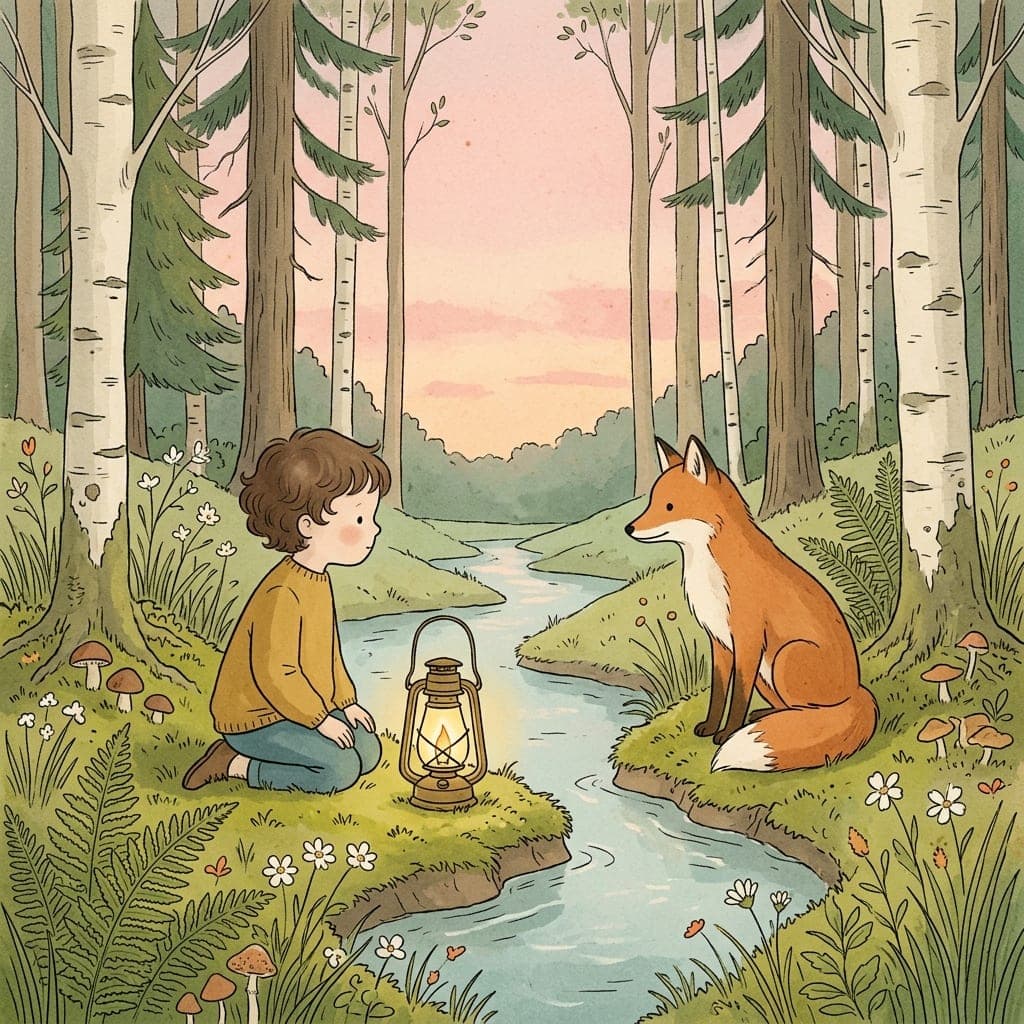
A children's book in the Art Nouveau style
Flowing lines, curling ornaments, huge plants and tiny figures. Around 1900 a visual language for fairy tales emerged that is still the benchmark.
Read the whole story for freeThe same style throughout the bookeBook £4.50
The golden age of illustration
Around 1900, a technical development met an artistic surge. New colour printing processes made it possible for the first time to print rich colour plates in large numbers. In Britain and the United States, the Golden Age of Illustration began, roughly from 1880 to 1920, with lavish gift books.
Arthur Rackham illustrated the Brothers Grimm's fairy tales for Freemantle in London in 1900, first with a hundred black-and-white pictures, revised and reissued by Constable in 1909. Edmund Dulac followed in 1907 with fifty colour plates for Stories from the Arabian Nights, and Kay Nielsen in 1914 with twenty-five plates for East of the Sun and West of the Moon, a collection of Nordic tales.
Alongside this, a German branch emerged, called Jugendstil there. Otto Ubbelohde made some 446 pen drawings for the Grimm tales between 1906 and 1908, published from 1907 by Turm Verlag in Leipzig.
The technical range under one label is striking: Rackham works with a textured web of lines in muted tones, Dulac and Nielsen painterly and flat, almost without a continuous outline.
The names behind it
Arthur Rackham
The Fairy Tales of the Brothers Grimm, Freemantle & Co, London, 1900
A hundred black-and-white illustrations, revised and reissued by Constable in 1909. His textured web of lines in muted tones became the very image of fairy-tale illustration.
Edmund Dulac
Stories from the Arabian Nights, Hodder & Stoughton, 1907
Fifty colour plates. He works in painterly flat areas, almost without outline, with generous colour: the opposite of Rackham.
Kay Nielsen
East of the Sun and West of the Moon, Hodder & Stoughton, 1914
Twenty-five colour plates for Nordic tales. His highly stylised pictures, built like ornaments, are seen as the high point of the era.
Otto Ubbelohde
Kinder- und Hausmärchen (Children's and Household Tales) by the Brothers Grimm, Turm Verlag, Leipzig, 1907
Some 446 pen drawings, made from 1906 to 1908. The German counterpart to Rackham.
Heinrich Vogeler
Dir. Gedichte, Schuster & Loeffler, Berlin, 1899
From the Worpswede artists' colony. He embodies Jugendstil in book art, where text, picture and layout form a whole.
How do you recognise Art Nouveau?
- Curving, ornamental lines running through the whole picture.
- Floral and plant motifs, often large next to the figures.
- Flat stylisation rather than naturalistic depth.
- A decorative frame around the picture, sometimes with its own border of ornaments.
- Muted colours or carefully placed contrasts, rarely a garish abundance.
Which stories Art Nouveau suits
Art Nouveau is the visual language of the fairy tale: everything about forests, water, transformation, magic, old stories. It brings a solemnity that modern styles lack, and for a gift book that's often exactly what you're looking for.
For everyday stories it's a poor fit. A child brushing their teeth in this style becomes unintentionally funny, because the style brings a grandeur that doesn't match the subject.
In terms of age, it suits children from about five. Younger ones find the figure in the ornament harder, because both are drawn with the same strength.
Good to know
Isn't Art Nouveau too old-fashioned for a children's book?
For an everyday story, yes. For a fairy tale or a gift book, that's exactly its charm: the style brings a solemnity that modern visual languages lack. It works well for big occasions, such as a christening.
From what age does this style suit?
From about five. Because the figure and the ornament are drawn with the same strength, younger children take longer to find the hero. Older ones discover something new with every reading.
Where does this style come from?
From the years around 1900, when new printing processes made rich colour plates possible. Britain had its golden age of illustration, with Arthur Rackham and Edmund Dulac; Germany had a branch of its own, represented by Otto Ubbelohde's Grimm illustrations.
Does the style stay the same throughout the book?
Yes. All 14 double pages are illustrated in the style you choose, and so are the cover and the character's portrait.
- 1.Wikisource: The Fairy Tales of the Brothers Grimm, illustrated by Arthur Rackham.What it confirms: First edition in 1900 from Freemantle & Co, a hundred black-and-white illustrations, reissued in 1909 by Constable & Co.
- 2.Wikisource: Stories from the Arabian Nights, illustrated by Edmund Dulac.What it confirms: London, 1907, Hodder & Stoughton, fifty colour plates.
- 3.Kay Nielsen, overview of his work.What it confirms: East of the Sun and West of the Moon, London, 1914, Hodder & Stoughton, twenty-five colour plates.
- 4.Büchner Verlag: Otto Ubbelohde's illustrations for the Brothers Grimm's tales. (in German)What it confirms: Some 446 pen drawings, made from 1906 to 1908, published from 1907 by Turm Verlag, Leipzig.
- 5.Heinrich-Vogeler-Gesellschaft: symbolism and Jugendstil in Vogeler's work. (in German)What it confirms: Vogeler's role in German Jugendstil and the Worpswede artists' colony.
The other styles
- 3D animation
- Andean textile art
- Chinese ink
- Coloured pencil
- Cordel woodcut
- Fine pen
- Graphic and simple
- Graphic novel
- Ink and watercolour
- Ligne claire
- Minhwa world
- Nordic fairy tale
- Paper collage
- Retro gouache
- Risograph
- Silhouettes
- Tingatinga world
- Ukiyo-e inspired
- Watercolour
- Wax crayon
At a glance: all illustration styles, how it works, frequently asked questions, the book without a photo, reading the story before you buy and the AI children's book.