Illustration style
A children's book in Chinese ink
Water, ink, brush and absorbent paper: from these few means grew a painting in China in which the brushstroke is both subject and handwriting. Our pictures in this style are a present-day children's book interpretation, inspired by this tradition.
Read the whole story for freeThe same style throughout the bookeBook £4.50
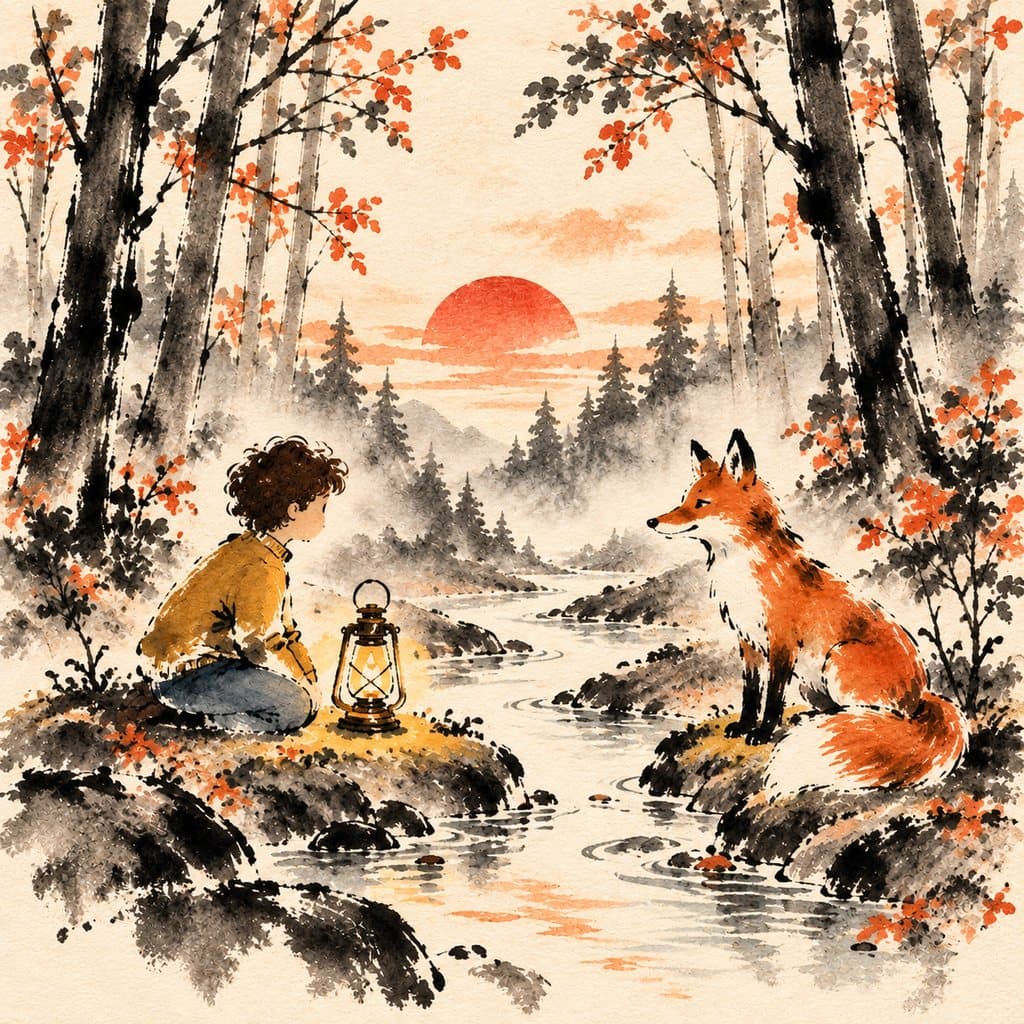
Water, ink and the handwriting of the brush
Shuimo literally means “water and ink”. Behind it stands no single school but a tradition over many centuries with very different directions: carefully built landscapes as well as quick, strongly abbreviated brushwork. Anyone who speaks of “the” Chinese ink therefore always simplifies. This page names three painters from three eras and describes what our pictures draw on.
The material is quickly explained. Ink is formed from soot and glue into a solid stick. To paint, you rub it with a little water on the inkstone, which also serves as a reservoir for the liquid ink. The amount of water determines the tone: more water gives lighter tones, less a deeper black. Added to this are brush and paper, which together with the inkstick and inkstone count as the “Four Treasures” of the scholar's studio. Gradations also arise within a single stroke, because the wet brush thins the ink towards its tip.
In China, painting and writing developed hand in hand and share their tools. From the brushstroke, connoisseurs read the character and bearing of the person painting. This becomes especially clear in the Yuan period (1279-1368): after the Mongol conquest, many leading scholars withdrew from state service, wrote poems and painted. Like calligraphy, they understood a picture as an expression of the person and often put verses on the picture itself. Poetry, calligraphy and painting were regarded as the “Three Perfections” of scholarly culture.
In the Song period (960-1279), Guo Xi worked as a court painter. His picture Early Spring of 1072 builds a mighty mountain from textured strokes, wrapped in clouds. In the Yuan period, Ni Zan (1301-1374) painted landscapes in pale tones, with a dry brush and few motifs, in which empty space speaks as well. Painting has also made practical use of empty space: water and snow are often painted by leaving the area unpainted and working only its surroundings.
Qi Baishi (1864-1957) stands for the twentieth century. He came from a farming family and painted shrimps, gourds, frogs and implements of country life with a few quick strokes. Our pictures take up individual features of this: tonal steps, dry and wet brush traces, bare paper as water and mist. They are a free adaptation into a present-day children's book, not a reproduction of this painting. Written characters and seals are not part of it.
The names behind it
Guo Xi
Early Spring, hanging scroll, ink and light colours on silk, National Palace Museum, Taipei, 1072
Court painter under Emperor Shenzong. His most famous picture builds a monumental landscape from textured strokes reminiscent of curled clouds.
Ni Zan
The Rongxi Studio, National Palace Museum, Taipei
The Yuan-period painter (1301-1374) is known for pale ink tones, dry brushwork and calm, wide pictorial spaces. Later generations painted in his manner.
Qi Baishi
Gourds, hanging scroll, ink and colours on paper
The twentieth-century painter (1864-1957) managed with a few brushstrokes and the play of light and dark ink. His brushwork grew out of calligraphy and seal carving.
How do you recognise Chinese ink?
- Ink in many tonal steps, from the deep black of tree trunks to the pale breath of mist.
- Softly flowing, wet edges beside broken, dry brush traces, on trunks and rocks for instance.
- Unpainted paper that plays its part as water, mist and distance: the river consists to a large extent of empty space.
- Colour used sparingly, as a few translucent touches of vermilion and ochre, in autumn leaves, the sun and the fox for instance.
- Figures and animals small and tersely built, the darkest masses on trees and rocks, not in the faces.
Which stories Chinese ink suits
This style carries calm, atmospheric stories: a walk through the forest, a river in the morning mist, a journey through the seasons, dusk by the water. The empty space gives the mood room, and the figures may stay small.
It is less suited to stories that live on fine expressions, details of clothing or many small objects. Because figures are made from few strokes, hair shape and hair colour, silhouette and one typical feature carry the recognition.
Our pictures remain a present-day children's book interpretation: narratively painted children and animals, warm, sparing colour, inspired by water-and-ink painting. As an age recommendation, “from about four years” is an editorial judgement, because the pictures invite close looking.
Good to know
What is the difference between Chinese ink and “ink and watercolour”?
“Ink and watercolour” means the European pen drawing: first a fine line is made with the pen, then colour is added over it. Chinese ink works with the brush and with ink rubbed fresh in many tonal steps. The single stroke carries form and handwriting, and empty paper belongs to the picture as water or mist.
Is this real Chinese painting?
Our pictures are a present-day adaptation into a children's book. They let themselves be inspired by water-and-ink painting but take up only individual features. The tradition itself comprises many schools and centuries, and we do not paint written characters or seals.
Why is so much paper left empty?
In this tradition, empty space belongs to the picture. Water, mist, distance or snow often arise by leaving the area unpainted and working only its surroundings. In our pictures, bare paper takes on the same task.
Will you recognise the figures if they consist of only a few strokes?
We keep every figure recognisable through hair shape and hair colour, silhouette and one feature. Faces stay light and calm, and the dark ink belongs to the trees and rocks.
Does the style stay the same throughout the book?
Yes. All 14 double pages are illustrated in the style you choose, and so are the cover and the character's portrait.
- 1.National Palace Museum Taipei: Early Spring, Guo Xi, 1072.What it confirms: The picture of 1072 is a hanging scroll in ink and light colours on silk; Guo Xi was court painter under Emperor Shenzong (1068-1085) and used textured strokes for the mountain slopes.
- 2.National Palace Museum Taipei: The Rongxi Studio, Ni Zan.What it confirms: Ni Zan's picture works with the composition “one river, two banks”, pale ink tones and the alternation of filled and empty areas.
- 3.National Palace Museum Taipei: Museum Paintings and Their Labels (Ni Zan, Shen Zhou, Wen Zhengming).What it confirms: Ni Zan lived 1301-1374, and later painters down to the Qing period painted landscapes in his style.
- 4.Asian Art Museum San Francisco: Brushstrokes, Styles and Techniques of Chinese Painting (teaching materials, 1995).What it confirms: Painting and writing share tools; Yuan scholars painted as an expression of the person; Ni Zan for pale ink and dry brush; water and snow through unpainted areas; Qi Baishi's Gourds.
- 5.Smithsonian National Museum of Asian Art: Four Treasures of a Scholar's Studio.What it confirms: Inkstick made of soot and glue, rubbed with water on the inkstone; the amount of water determines how light or dark the ink becomes.
- 6.Smithsonian National Museum of Asian Art: Painting with Words, Gentleman Artists of the Ming Dynasty.What it confirms: Poetry, calligraphy and painting are regarded as the “Three Perfections” of scholarly culture.
- 7.Hong Kong Museum of Art, government press release (24.08.2006): Likeness and Unlikeness, Qi Baishi.What it confirms: Qi Baishi (1864-1957) came from a farming family and painted shrimps and other motifs of country life with a few brushstrokes.
- 8.Museum of Fine Arts Boston: Qi Baishi, Inspiration in Ink (2025).What it confirms: Qi's expressive brushwork rests on calligraphy and seal carving, and his pictures are marked by a great economy of form.
- 9.Wikipedia: Ink wash painting.What it confirms: Shuimo (水墨画) literally means “water and ink”; the painting flourished from the Song period (960-1279).
The other styles
- 3D animation
- Andean textile art
- Art Nouveau
- Coloured pencil
- Cordel woodcut
- Fine pen
- Graphic and simple
- Graphic novel
- Ink and watercolour
- Ligne claire
- Minhwa world
- Nordic fairy tale
- Paper collage
- Retro gouache
- Risograph
- Silhouettes
- Tingatinga world
- Ukiyo-e inspired
- Watercolour
- Wax crayon
At a glance: all illustration styles, how it works, frequently asked questions, the book without a photo, reading the story before you buy and the AI children's book.