Illustration style
A children's book in cut-paper silhouettes
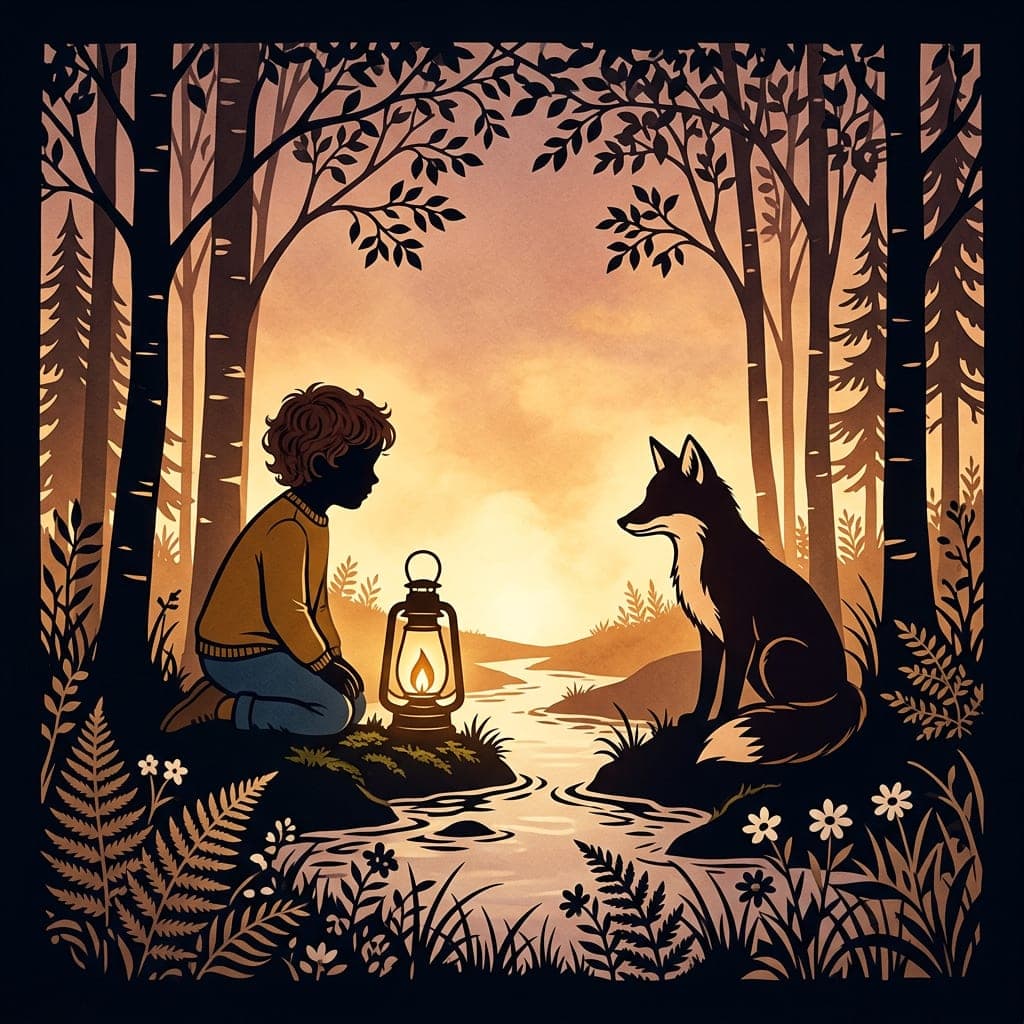
A figure reduced to its outline. No face, no inner drawing, only a shape against the light. It seems like very little, and yet this technique has told stories for centuries.
Read the whole story for freeThe same style throughout the bookeBook £4.50
From cut paper to the first animated feature film
The word itself comes from French. Several writers, among them Louis-Sébastien Mercier and Honoré de Balzac, link it to the name of Étienne de Silhouette, France's finance minister for a few months in 1759 and remembered for his unpopularity.
As an art of cutting, the silhouette has a long tradition in Germany and Switzerland. In the nineteenth century, Paul Konewka was regarded, according to the Deutsche Biographie, as the most important German artist of the form; his silhouettes for Shakespeare's A Midsummer Night's Dream appeared in Heidelberg in 1868.
The step from paper to storytelling was taken by Lotte Reiniger. Between 1923 and 1926 she made The Adventures of Prince Achmed, and the number attached to it is dizzying: more than 250,000 frames were shot for the premiere version. She cut figures and sets by hand from black card and lead, mounted them with joints on a light table and photographed each phase of movement separately.
The result, a film of just over an hour, is regarded as the oldest surviving animated feature film. It was made a decade before Disney's Snow White, and the Deutsches Filmmuseum in Frankfurt restored it in 1999.
For a children's book, this means the visual language comes from fairy tales and the shadow theatre. It was telling stories before the picture book existed in its present form.
The names behind it
Lotte Reiniger
The Adventures of Prince Achmed (Die Abenteuer des Prinzen Achmed), 1926
She brought the cut-paper silhouette to the cinema and made the oldest surviving animated feature film. More than 250,000 frames, each phase of movement set by hand.
Paul Konewka
Silhouettes for Shakespeare's A Midsummer Night's Dream, 1868
According to the Deutsche Biographie, the most important German silhouette artist of the nineteenth century. His pictures show how much a simple outline can express.
Marcus Behmer
Zehn Scherenschnitte (Ten silhouettes), Berlin, W. Büxenstein, 1930
An illustrator who worked for the publisher Insel Verlag among others. His cut-paper work marks the technique's entry into book art in the early twentieth century.
How do you recognise cut-paper silhouettes?
- Areas of a single colour without any inner drawing, usually black, on a light or coloured background.
- The whole shape runs through the outer outline. What doesn't show at the edge doesn't exist.
- Often profiles, because a profile reads better than a front view.
- A backlit mood: the scene seems to stand in front of a lit surface.
- Details become silhouette signs: a plait, glasses, a cape, a woolly hat.
Which stories silhouettes suit
Silhouettes are strong when a story needs atmosphere more than expressions: fairy tales, bedtime stories, everything about forests, night, journeys or transformation. The missing face becomes an advantage, because children put the feeling in themselves.
They suit stories that rest on fine emotions, or on many characters acting at once, less well, because overlapping silhouettes are hard to tell apart.
In terms of age, they suit children from about four. Younger ones need colour and inner drawing to name things; for them, paper collage or wax crayon are easier to read.
Good to know
Will my child recognise themselves in a silhouette?
By the signs visible in the outline: the hairstyle, the glasses, the favourite hat, a teddy under the arm. That's exactly what we ask for in the description. Skin and eye colour play no part in this style, silhouette signs all the more.
Aren't silhouettes too dark for children?
The pictures are high-contrast, usually on a bright or coloured background, and the figures stand out against the light. The effect is that of a shadow theatre.
From what age does this style suit?
From about four. Before that, colour and inner drawing help children look, because they want to name things. After that, the pared-down shape becomes a game.
Does the style stay the same throughout the book?
Yes. All 14 double pages are illustrated in the style you choose, and so are the cover and the character's portrait. The style never changes partway through the book.
- 1.Étienne de Silhouette, overview. (in French)What it confirms: France's finance minister in 1759; several writers, including Mercier and Balzac, see him as the origin of the word “silhouette”.
- 2.Deutsche Biographie: Paul Konewka. (in German)What it confirms: Konewka, regarded as the most important German silhouette artist of the nineteenth century; silhouettes for A Midsummer Night's Dream, Heidelberg 1868.
- 3.Deutsches Filminstitut und Filmmuseum (DFF): Die Abenteuer des Prinzen Achmed. (in German)What it confirms: Made from 1923 to 1926, more than 250,000 frames for the premiere version, oldest surviving animated feature film, restored in 1999.
- 4.Metropolitan Museum of Art: Marcus Behmer.What it confirms: Behmer, book artist and illustrator of the early twentieth century.
The other styles
- 3D animation
- Andean textile art
- Art Nouveau
- Chinese ink
- Coloured pencil
- Cordel woodcut
- Fine pen
- Graphic and simple
- Graphic novel
- Ink and watercolour
- Ligne claire
- Minhwa world
- Nordic fairy tale
- Paper collage
- Retro gouache
- Risograph
- Tingatinga world
- Ukiyo-e inspired
- Watercolour
- Wax crayon
At a glance: all illustration styles, how it works, frequently asked questions, the book without a photo, reading the story before you buy and the AI children's book.