Illustration style
A children's book in the world of minhwa
Minhwa means “people's picture” and names Korean folk painting, above all from the Joseon period. The pictures hung in living rooms, accompanied festivals and carried wishes for good fortune and a long life. Our minhwa world is inspired by this and carries its visual language over into your story.
Read the whole story for freeThe same style throughout the bookeBook £4.50
Pictures for everyday life, by hands nobody knows
Minhwa arose and flourished in the Joseon period, which lasted from 1392 to 1910. At first, court painters painted for the palaces. Later, painters from the middle and lower classes spread pictures for ordinary people. Many of them travelled around, often following the festivals, and worked on commission. Their names have, as a rule, not been handed down. That is part of the story: minhwa is an art of many hands.
The pictures served daily use. They decorated walls, doors and folding screens and were hung at the New Year so that the year would bring good fortune. They expressed wishes: for luck, prosperity, health and a long life. According to a common list, the motif of the “Ten Symbols of Longevity” brings together the sun, mountains, water, rocks, pines, clouds, turtles, cranes, deer and the mushroom of immortality.
Animals and plants carry meaning here. Fish stand for prosperity, peaches for eternal life, peonies for wealth, cranes for long life, and pines likewise. Humour and mockery also belong to the pictorial world: the motif of the tiger and the magpie is interpreted as a satire on the rank order of Joseon society.
The term “minhwa” itself was introduced in the early twentieth century by the Japanese aesthete Sōetsu Yanagi. Some Korean specialists therefore prefer the older expression “sokhwa” for folk painting. During Japanese colonial rule and the Korean War the tradition declined; in the 1980s it experienced a revival that continues to this day.
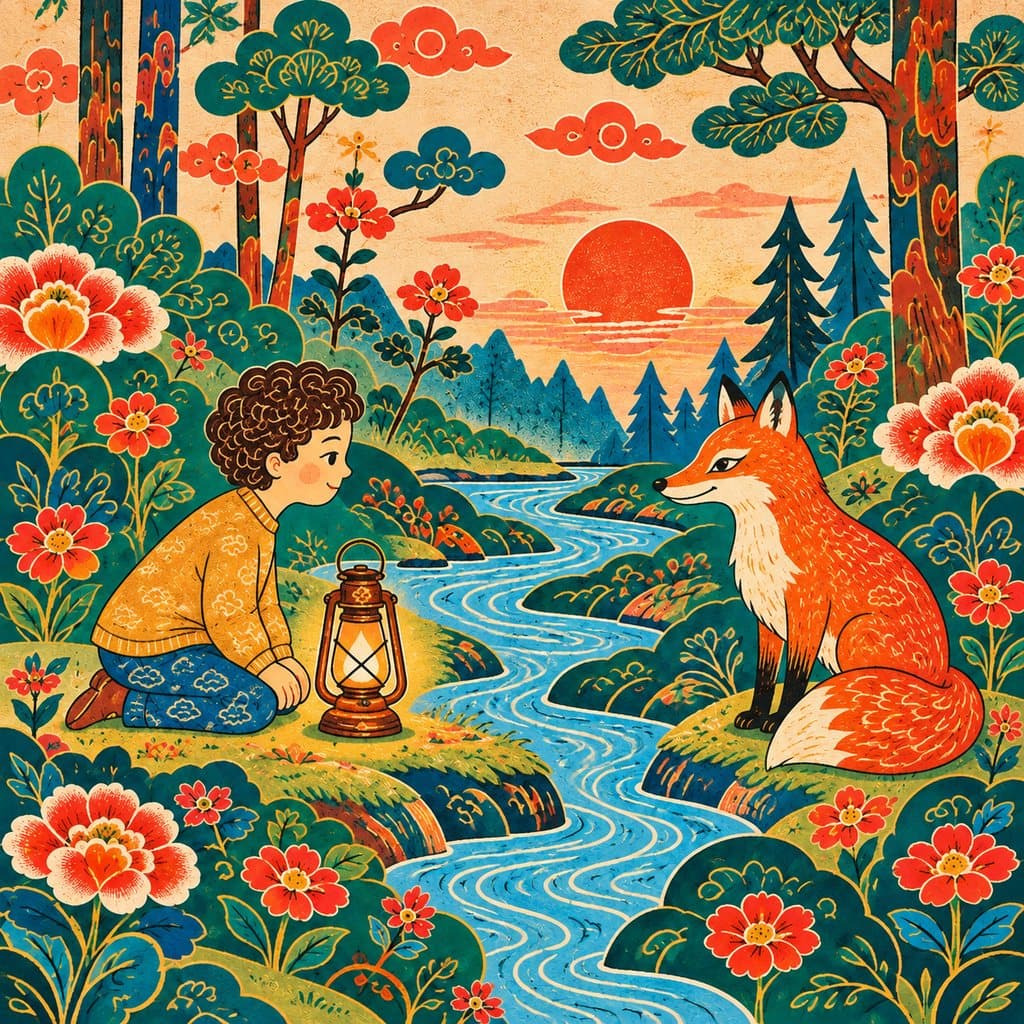
Our pictures are a free adaptation of this tradition. The flat arrangement, the outlines, the colour world and the decorative plants take up minhwa. That a fox sits by a European forest river is our invention and does not occur in historical folk painting.
The names behind it
The anonymous painters of the Joseon period
Minhwa for walls, doors and folding screens, 1392 to 1910
They carried the tradition: itinerant painters and craftspeople from among the people, whose names have almost never been handed down. A list of individual artists therefore reflects minhwa only in part.
Sōetsu Yanagi
Co-founding of the Korean Folk Art Museum in Seoul, 1924
He collected and promoted Korean folk art and introduced the term “minhwa”; the museum arose under Japanese colonial rule and belongs to the early history of today's National Folk Museum of Korea.
Song Kyu Tae
Minhwa exhibition at the Kyungin Exhibit Hall, Seoul, 2010
Regarded as a master of traditional Korean folk painting who taught the next generation of minhwa artists, and associated with the revival of minhwa since the 1980s.
Song Chang Soo
Exhibition Minhwa: The Elegance of Korean Folk Paintings, Korean Cultural Centre Los Angeles, 2024
Professor at Dongduk Women's University and a direct student of Song Kyu Tae; with his artists he shows traditional and newly created minhwa.
How do you recognise the world of minhwa?
- Glowing, saturated colours such as malachite green, vermilion, indigo blue and ochre yellow on a warm, slightly fibrous paper ground.
- Clear outlines around figures, blossoms and rocks, with hardly any shading.
- A flat, decorative arrangement: space arises from the layering of shapes, not from a single central perspective.
- Stylised plants, clouds and pines in a rhythmic pattern, water as curving lines.
- Animals with expressive, slightly roguish faces that form the centre of the picture.
Which stories the world of minhwa suits
This pictorial world suits stories about animals, plants and nature well: forest, river, garden, journey. There, decorative blossoms, clouds and water come into their own. Stories about wishes, festivals and good fortune also fit the origin of the visual language, in which pictures were hung for exactly that purpose.
The classification matters: the pictures are a present-day children's book adaptation, inspired by minhwa. A scene like the fox by the forest river is our free adaptation. We take over the effect of colour and the language of form; we do not prescribe the meaning of individual symbols. Traditionally, minhwa is painted with mineral pigments on hanji, a paper made from the inner bark of the mulberry tree. Our pictures show this effect of colour but are not works painted in that way.
The style is less suited to stories that rely on spatial depth or precisely drawn architecture. In terms of age, it suits children from about three: the clear shapes and glowing colours are easy to take in, and the many small blossoms and patterns invite searching.
Good to know
Who painted minhwa?
Mostly unknown painters from among the people, often itinerant painters who worked for ordinary people. That is why there are hardly any known artists' names from the Joseon period. Those who can be named are mainly intermediaries and present-day teachers such as Song Kyu Tae and Song Chang Soo.
Are the pictures real Korean folk painting?
No, they are a free adaptation. They take up the colours, outlines, flat arrangement and decorative plants of minhwa but tell your own story, for example with a fox by a European forest river, which does not occur in historical minhwa.
Do the animals and plants in the picture have a fixed meaning?
In historical minhwa, often yes: pines and cranes stand for long life, peonies for wealth. In our pictures they serve mainly for the design. We do not attribute a fixed meaning to them.
From what age does the world of minhwa suit?
From about three years. The clear outlines and strong colours are easy to take in, and the patterns in blossoms and clouds invite close looking.
Does the style stay the same throughout the book?
Yes. All 14 double pages are illustrated in the style you choose, and so are the cover and the character's portrait.
- 1.FIT Art History Blog: Renewal of Symbols. Contemporary Minhwa Paintings, exhibition at the Fashion Institute of Technology, New York, 2022.What it confirms: The names of most minhwa artists are unknown; the pictures express wishes for long life and good fortune and were made with hanji, ink and pigments.
- 2.The Korea Times: Modern minhwa artist paints luck, everyday hope in Korean folk art, 14.01.2026.What it confirms: Minhwa arose largely through anonymous artists outside the elite, shows strong colours and flat spatial composition without shading, and carries motifs such as fish, peaches, peonies and cranes with fixed meanings.
- 3.Korean Cultural Center New York: MINHWA & minhwa. Korean Folk Paintings in Dialogue With the Contemporary, 2020.What it confirms: At first court painters painted for palaces; later anonymous painters from the middle and lower classes spread minhwa for ordinary people.
- 4.Wikipedia: Minhwa.What it confirms: The term minhwa was introduced in the early twentieth century by Sōetsu Yanagi, the tradition experienced a revival in the 1980s, and there was humour and satire in the pictures.
- 5.Wikipedia: Chōsen Folk Art Museum.What it confirms: The museum was opened on 9 April 1924 by the Asakawa brothers and Sōetsu Yanagi in Gyeongbokgung in Seoul and later merged into the National Folk Museum of Korea.
- 6.The Korea Times: Minhwa, Korean folk art, flourishes anew in Seoul, 19.06.2025.What it confirms: Minhwa flourished in the later centuries of the Joseon period; pines stand for long life, pairs of birds for marital harmony.
- 7.Gwangju News: Minhwa, Painting the Peoples' Desires.What it confirms: Minhwa hung on walls, doors and folding screens so that the year would bring good fortune, and carried people's hopes and wishes.
- 8.Gallery& Studio: Minhwa, The Beauty of Everyday Things, 2026.What it confirms: Traditional minhwa works with mineral pigments on hanji from the inner bark of the mulberry tree and shows motifs such as the Ten Symbols of Longevity.
- 9.Beverly Press: KCCLA explores traditional Korean art styles, August 2024.What it confirms: Song Chang Soo, professor at Dongduk Women's University, was taught directly by Song Kyu Tae and led the artists of the exhibition at the Korean Cultural Center Los Angeles from 8 to 22 August 2024; Song Kyu Tae is regarded as a formative figure of minhwa painting.
- 10.Chapman University: Dean Kafatos artwork included in Korean exhibit, 30.09.2010.What it confirms: A minhwa exhibition at the Kyungin Exhibit Hall in Seoul was organised in September 2010 by the master artist Kyu Tae Song; minhwa was revived in the 1980s.
The other styles
- 3D animation
- Andean textile art
- Art Nouveau
- Chinese ink
- Coloured pencil
- Cordel woodcut
- Fine pen
- Graphic and simple
- Graphic novel
- Ink and watercolour
- Ligne claire
- Nordic fairy tale
- Paper collage
- Retro gouache
- Risograph
- Silhouettes
- Tingatinga world
- Ukiyo-e inspired
- Watercolour
- Wax crayon
At a glance: all illustration styles, how it works, frequently asked questions, the book without a photo, reading the story before you buy and the AI children's book.