Illustration style
A Risograph children's book
Risography is a stencil printing process from Japan. Each colour is printed separately, and where two colours overlap, a third appears. That is where the few glowing tones, the grainy surfaces and the small misregistrations come from.
Read the whole story for freeThe same style throughout the bookeBook £4.50
From copying machine to designers' colour
Risography is a stencil process. The machine uses a thermal head to cut fine openings into a thin film, the so-called master, and wraps it around a print drum. The drum holds ink in exactly one colour. As it turns, it presses the ink through the openings onto the paper passing beneath it.
Because a drum holds only one colour, a multicoloured image is split into separate colour layers: each layer gets its own master, and the paper runs through the machine once for each colour. The inks are semi-transparent. Where two layers lie on top of each other, a third colour is mixed in the overprint. Because the paper is fed in afresh for every pass, the layers never sit exactly on top of one another. This misregistration, and small differences within a print run, belong to the process and are part of its look.
The technique comes from Tokyo. Noboru Hayama opened the duplicating business RISO-SHA there on 2 September 1946. “Riso” means “ideal” in Japanese. In 1958 the company launched its own machine, the RISO-GRAPH, in 1980 came the RISOGRAPH brand, and in 1986 the first digital machine, the Digital 007. These machines were developed to copy documents quickly and cheaply, not for art.
Designers, illustrators and small print studios later discovered what the process makes visible: strong solid colours, grain, overlays and chance. RISO itself writes that the machines are popular with artists worldwide, especially in Europe. Gabriella Marcella got to know the Riso printer at the Pratt Institute in Brooklyn and built up the studio RISOTTO in Glasgow. In London, Jackson Lam and Ken Kirton founded Hato Press in 2009, which publishes zines and books in Risograph print.
Our pictures are not Risograph prints. They are not made on a RISO machine; they are present-day children's book illustrations that freely reproduce the character of the print: a few fixed colours, overlays, grain and slight misregistration.
The names behind it
Noboru Hayama
Founding of the duplicating business RISO-SHA in Tokyo, 1946
His business grew into the company whose machines gave the printing process its name.
Gabriella Marcella
RISOTTO, print studio in Glasgow
She developed her work out of the speed and unpredictability of the Riso printer and makes posters, murals and publications with it.
Jackson Lam and Ken Kirton
Hato Press, London, 2009
They founded the press to make printing and production more accessible to artists, and by 2020 had published around 50 zines in Risograph print.
How do you recognise Risograph?
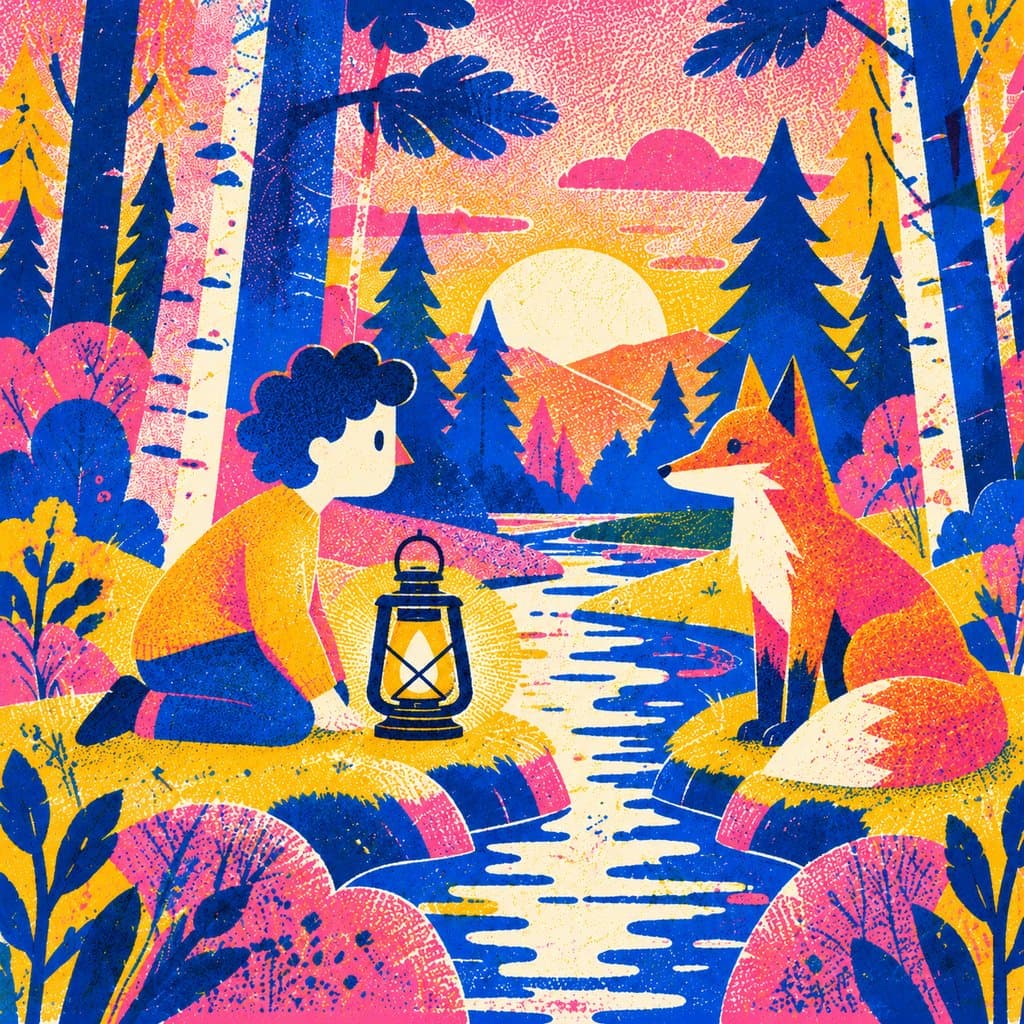
- Three or four glowing solid colours; in our example picture, pink, cobalt blue and sunflower yellow on warm, cream-coloured paper.
- Mixed colours arise only through overprinting: blue over pink gives violet, yellow over pink gives orange.
- Grainy, speckled areas, denser in places and lighter in others, with the paper showing through.
- Small misregistrations, where one colour layer sits just beside another.
- Large, simple shapes without an outline of their own and without soft gradients.
Which stories Risograph suits
The style lives on large, clear shapes and a few colours. It suits nature, animals and moods well: a forest, a river, dusk, a fox, a lantern. In our example picture the colour layers do exactly that, with a sky in pink and yellow, trees in blue and a fox in yellow and pink.
Because only a few colours are available, skin, hair and clothing are translated into those colours. The character stays recognisable by shape, hairstyle and clothing, but is more graphic than in a painted style. The grain is less suited to fine facial expressions.
The pictures feel fresh and playful. The simple shapes are easy to take in, so the style suits children from about two to three years. That is an editorial judgement, not a fixed age limit.
Good to know
How does Risograph differ from screen printing?
Both press ink through a stencil and work with solid colours. In Risograph printing, the machine produces the stencil itself, wraps it around a drum and prints automatically, each colour in a separate pass. That makes the process quick and inexpensive for small print runs.
Are the pictures real Risograph prints?
No. The pictures are not made on a RISO machine. They are present-day children's book illustrations that freely imitate colour layers, overprinting, grain and misregistration.
Why are there so few colours?
In Riso printing, each drum carries exactly one colour, and every further colour means a further pass. All other tones arise when two colours overlap. Our pictures follow this limitation: three or four colours, with the rest created by overprinting.
From what age does the Risograph style suit?
From about two to three years. Large, simple shapes and clear colours are easy to recognise, and the grain rewards anyone who looks closely.
Does the style stay the same throughout the book?
Yes. All 14 double pages are illustrated in the style you choose, and so are the cover and the character's portrait.
- 1.RISO Kagaku Corporation: RISO's History.What it confirms: Noboru Hayama began in 1946 with a duplicating service under the name RISO-SHA; the RISO-GRAPH machine appeared in 1958.
- 2.RISO Deutschland: RISO, a Japanese print success story.What it confirms: The founding of RISO-SHA on 2 September 1946, the RISO-GRAPH in 1958 and the RISOGRAPH brand with the first machines in 1980.
- 3.RISO Inc.: About RISO.What it confirms: The meaning of “Riso” as “ideal”, and the first digital machine, the Digital 007, in 1986.
- 4.RISO Kagaku Corporation: RISO ART.What it confirms: RISOGRAPH has become popular with artists worldwide, especially in Europe.
- 5.University of Brighton: Visual Communication Technical Resource, Risograph Printing.What it confirms: The master is cut thermally and wrapped around a drum, each drum holds one colour, overlapping colours produce mixed colours, and there are irregularities within a print run.
- 6.Victoria and Albert Museum: Gabriella Marcella, The power of printing, 2018.What it confirms: Marcella got to know the process at the Pratt Institute and founded RISOTTO in Glasgow, and the process works with solid colours and stencils, similar to screen printing.
- 7.Hato Press, entry on its founding and programme.What it confirms: Hato Press was founded in London in 2009 by Jackson Lam and Ken Kirton and had published around 50 zines in Risograph print by 2020.
The other styles
- 3D animation
- Andean textile art
- Art Nouveau
- Chinese ink
- Coloured pencil
- Cordel woodcut
- Fine pen
- Graphic and simple
- Graphic novel
- Ink and watercolour
- Ligne claire
- Minhwa world
- Nordic fairy tale
- Paper collage
- Retro gouache
- Silhouettes
- Tingatinga world
- Ukiyo-e inspired
- Watercolour
- Wax crayon
At a glance: all illustration styles, how it works, frequently asked questions, the book without a photo, reading the story before you buy and the AI children's book.