Illustration style
A children's book in the world of Tingatinga
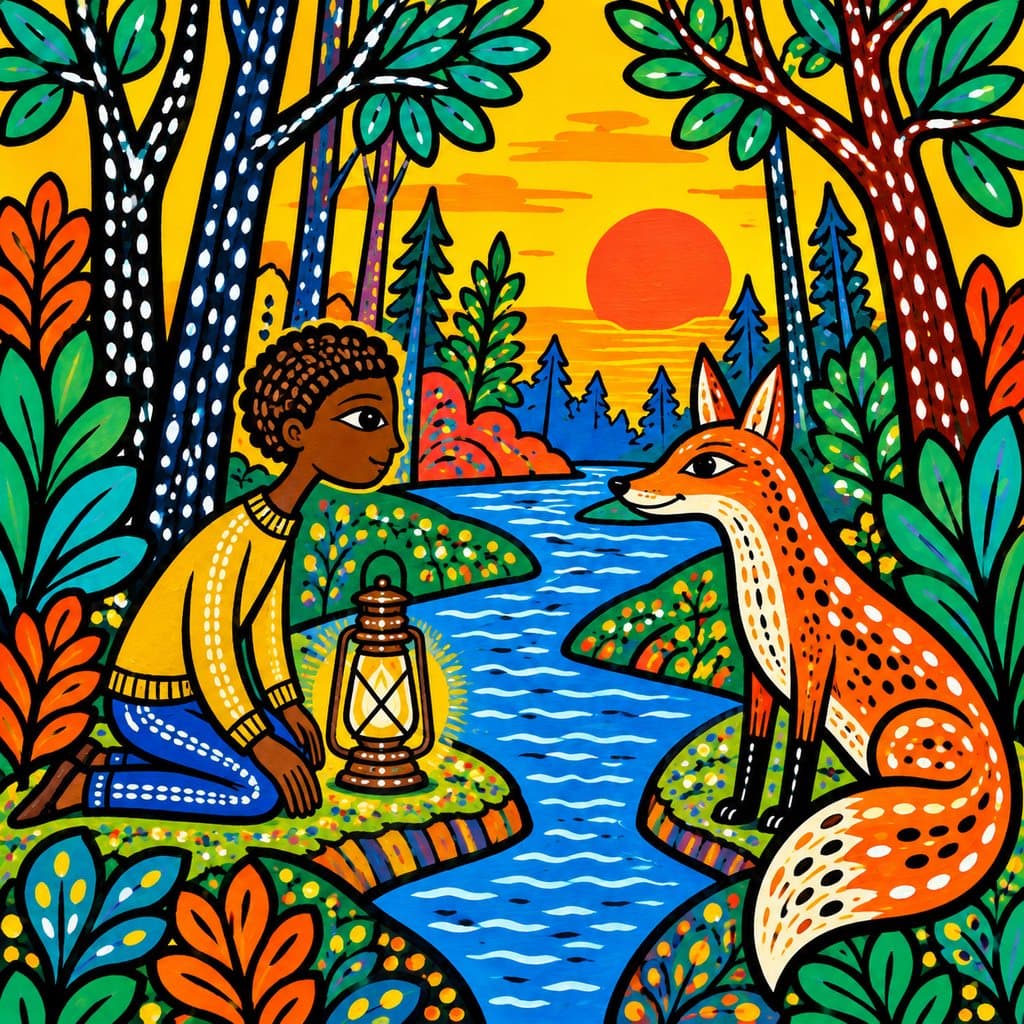
Tingatinga is a school of painting from Dar es Salaam in Tanzania, named after its founder Edward Saidi Tingatinga. Our pictures are inspired by it: strong colours, dark outlines, animals with patterns inside.
Read the whole story for freeThe same style throughout the bookeBook £4.50
A school of painting from Dar es Salaam
Tingatinga painting is a modern art school with a history of its own. It goes back to Edward Saidi Tingatinga, who began to paint in Dar es Salaam at the end of the 1960s. He worked on square panels in strong colours and showed mainly animals but also people. His success got around, and young painters joined him. This is how the school arose, which soon had its centre in Msasani, a village near Dar es Salaam.
The paint used was bicycle paint, a glossy enamel, on hardboard. The material gives the pictures their opaque, glowing areas. Added to this are clear outlines and patterns inside the shapes: dots, stripes, swirls. That the paint looks almost like lacquer is part of the appearance.
Tingatinga died in 1972, and the school carried on. The Smithsonian Libraries summarise Yves Goscinny's book on the painting like this: the founder began in 1970 to train five pupils, namely Simon George Mpata, Tedo, Ajaba, Linda and Adeusi. This first generation trained a second, and the close circle around the founder opened up. According to the summary, a cooperative takes over sales and marketing, and the painting has become more varied.
The style has changed in the process. Tingatinga's own pictures were tidy and mostly showed a single animal. Later painters filled the free space with plants and further animals, and more recently city scenes and narrative pictures have been added. Our densely filled, heavily patterned look therefore corresponds more to the later generations of painters than to the early, sparing panels of the founder.
Our pictures are a present-day children's book adaptation and take over elements of this tradition freely: the strong outlines, the opaque colours, the patterns. The child by the forest river in our example picture and the characters in your book belong to this free adaptation. They do not come from Tingatinga painting itself.
The names behind it
Edward Saidi Tingatinga
Square panel pictures with single animals and people, Dar es Salaam
Founder and namesake of the school; his pictures mostly stayed with a single animal and plenty of free space.
Simon George Mpata
Tingatinga panel pictures, after 1972 in his own studio in Nairobi
One of the first pupils, described in the literature as particularly faithful to the style of his teacher.
Tedo, Ajaba, Linda and Adeusi
The other pupils of the first generation, trained from 1970
They carried the school on after 1972 and trained the second generation, which broadened the style.
How do you recognise the world of Tingatinga?
- Opaque, smoothly glossy areas of colour in strong blue, green, orange and yellow, as on a lacquered panel.
- Dark outlines around every shape: animals, trees, leaves and figures.
- Patterns inside the shapes, for example rows of dots on tree trunks and spots in the animals' fur.
- A densely filled picture: leaves, flowers and plants crowd in from the edges, and hardly any area stays empty.
- Faces of the figures kept calm, so that they remain the clearest thing in the crowd of patterns.
Which stories the world of Tingatinga suits
The style suits stories of animals, nature and adventure well: forest, river, savannah, garden. Animals are the great subject of this painting, and the pattern in fur or feathers can be invented anew in every scene.
The pictures are colourful, full of energy and rich in small things that can be discovered on close inspection. That suits cheerful, lively stories. For very quiet, thoughtful scenes the style is less obvious, because the dense pattern brings a lot of movement into the picture.
As a guide: from about three years, when children like to search for and name a lot on a page. That is an editorial judgement and not a fixed rule.
Good to know
Are these real Tingatinga paintings?
No. Our pictures are a present-day children's book adaptation, inspired by Tingatinga painting. They take up outlines, opaque colours and patterns but show scenes and figures of their own that do not occur in this tradition in that form.
What is traditionally used for painting in Tingatinga?
Bicycle paint, an enamel, on hardboard. The paint gives opaque, glossy areas. Our pictures take up this look but are not painted with such lacquer.
What did the first Tingatinga pictures look like?
They were mostly sparer than today's. Edward Saidi Tingatinga often showed a single animal. Later generations of painters filled the pictures with plants and further animals and also told scenes from the city. Our style corresponds more to this dense later form.
Does the style stay the same throughout the book?
Yes. All 14 double pages are illustrated in the style you choose, and so are the cover and the character's portrait. A change of style partway through the book does not happen.
- 1.Smithsonian Libraries: Modern African Art, A Basic Reading List, Tanzania, Tingatinga School.What it confirms: Square panels, school in Msasani near Dar es Salaam, death of the founder in 1972, the pupils Mpata, Tedo, Ajaba, Linda and Adeusi trained from 1970, and the development from single animal to filled picture and to city and narrative scenes.
- 2.Wikipedia: Edward Tingatinga.What it confirms: Tingatinga began painting in 1968 and died in 1972; as materials the article names, among others, Masonite boards and bicycle paint.
- 3.Indigo Arts: Tinga Tinga Today, Tanzanian Popular Art in Transition.What it confirms: High-gloss bicycle paint on hardboard as the original material, and the extension of the style from simple animal pictures to richer, denser pictures.
- 4.Wikipedia: Simon Mpata.What it confirms: Mpata (1942 to 1984) was a half-brother of Tingatinga, was one of the pupils taught directly, is regarded as particularly faithful to his style and moved to Nairobi after Tingatinga's death.
- 5.Fowler Museum at UCLA: Tingatinga (exhibition, 2022 to 2023).What it confirms: Tingatinga's pictures show flatly stylised, clearly outlined animals against a plain ground, and the style is passed on to this day.
The other styles
- 3D animation
- Andean textile art
- Art Nouveau
- Chinese ink
- Coloured pencil
- Cordel woodcut
- Fine pen
- Graphic and simple
- Graphic novel
- Ink and watercolour
- Ligne claire
- Minhwa world
- Nordic fairy tale
- Paper collage
- Retro gouache
- Risograph
- Silhouettes
- Ukiyo-e inspired
- Watercolour
- Wax crayon
At a glance: all illustration styles, how it works, frequently asked questions, the book without a photo, reading the story before you buy and the AI children's book.