Reading development · from birth to 12
Reading development in children
When does a child understand that a picture stands for something? What does school expect when reading begins, in Ireland, in England or in the United States? And how long should you keep reading aloud? This timeline puts twelve years side by side: what develops at each age, what school asks of your child, and what matters when you read together.
Every statement carries its source. Where our research found nothing reliable, we say so.
12 min read23 sources · accessed on 26 September 2026
Where things stand
Four figures give this timeline its scale. They describe whole countries and whole studies; your child is always a case of their own.
75%
of pupils in England met the expected standard in the Year 1 phonics screening check in 2022, compared with 82% in 2019.8
Department for Education, Explore Education Statistics
40
words make up the check: 20 real words and 20 pseudo-words, read aloud by children aged five to six.7
Department for Education, methodology
50,000+
children on the island of Ireland learn through Irish-medium education outside the Gaeltacht, and over 13,000 more within it.11
Gaelscoileanna, 2023
1,483,300
words from books heard before the age of five with five books a day. Without reading aloud, it's around 4,662.13
Ohio State University, 2019
- 0-6 months
Illustration style: watercolour The voice comes before the picture
From about two months, a baby links how they feel to the way their carer speaks to them. At three to four months, they connect events with what they hear and may already recognise their own name. From four months, they can tell a friendly tone from a cross one.3
They make themselves heard too: cooing from about two months, little squeals and grunts at around three.3
To read together
The American Academy of Pediatrics encourages shared reading from birth.12 At this age it's the voice that matters: your baby listens to the melody long before the words mean anything.
- 6-12 months
A picture is still an object
At five to six months, the first chains of syllables appear, like da-da-da. At around eight months, a child understands their first words.3
In front of a picture, they're at the very beginning. The developmental psychologist Judy DeLoache describes nine-month-olds trying to put their mouths on a drawn bottle: they recognise what is shown without yet understanding that the picture stands for a thing.1
To read together
Touching, chewing and turning pages are all part of reading at this age. A US study of more than 2,500 low-income families found a link between shared reading and a child's vocabulary from 14 months.2 The sample comes from one country and one particular situation, so the result doesn't carry over unchanged to every family.
- 1-2 years
Illustration style: paper collage The picture becomes a sign
Over time, children learn that a picture stands for a thing instead of being the thing itself. The source gives no age for this step, so watch your child: a picture can be read as the sign of a thing once they stop trying to grab it.1
First words mostly arrive between 12 and 18 months. At 20 months, a child with typical development says between 50 and 200 words.4
A classic for this age
To read together
Point, name, repeat. Your child points, you say the word, and you both look at the same thing. At this age there's no need to quiz a child about the story.
- 2-3 years
From reading to talking
Two-word sentences turn into three-word sentences.4
Feelings become more complex. Between 24 and 36 months, children begin to show feelings like embarrassment or shame, and two-year-olds already show empathy, for example by comforting another child who is crying.5
A classic for this age
To read together
This is the age of dialogic reading: the adult asks questions and lets the child tell the story. A meta-analysis of sixteen studies puts its average effect on the words a child uses at d = 0.59.6 The debates section further down explains why that number is only half the story.
- 3-4 years
Illustration style: retro gouache Why, how, and what happens next?
Sentences are joined with “and” or “then”, questions about why and how arrive, and rhymes are understood. A passing stammer is common at this age and usually harmless: the wish to speak runs ahead of the mouth.4
A classic for this age
To read together
The “whys” now come in the middle of the story. Let them: a question is a sign your child is following. If the answer would take too long, it can wait until the last page.
- 4-5 years
The first school year in Ireland
Subordinate clauses with “when” or “because” fall into place.4
In Ireland, a child can start primary school in Junior Infants in the September after turning four: they must be at least four on 1 September of the year they start. School becomes compulsory at six at the latest.9 Some schools decide for themselves whether to take four- or five-year-olds.9
For a growing number of Irish children, the school language is Irish: over 40,000 pupils attended 188 Gaelscoileanna at primary level in 2023.11
A classic for this age
To read together
A figure few people know: the effect of dialogic reading is clearly smaller in children aged four to five, according to the same meta-analysis.6 It concerns the question-and-answer technique only; it says nothing against reading aloud as such.
- 5-6 years
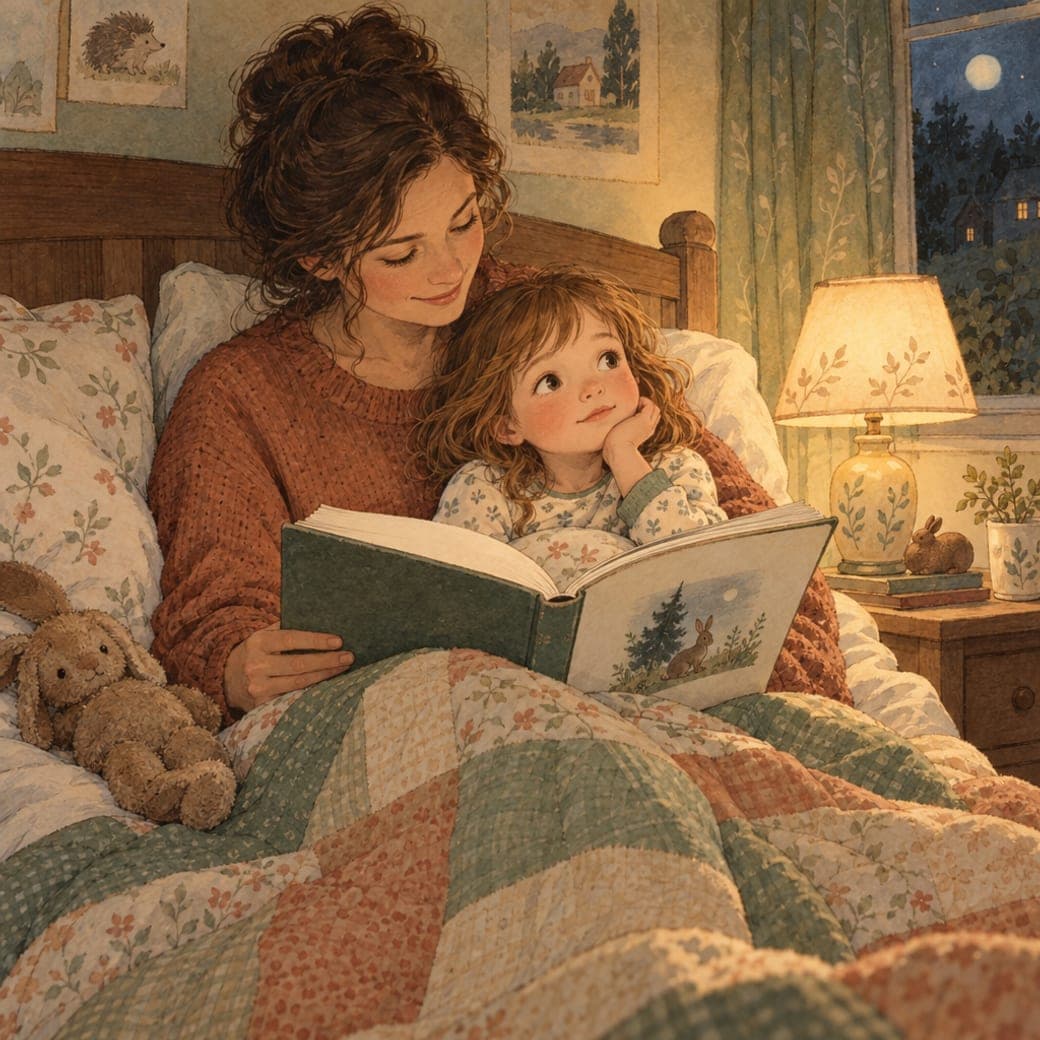
Illustration style: ink and watercolour Just before reading clicks
At around school age, a child uses more than 3,000 words, builds main and subordinate clauses with ease, and most children can split a word into syllables.4
In the United States, when a child starts kindergarten depends on the state. California, Florida, Texas, Georgia and Michigan use 1 September as the cut-off date; North Carolina, Massachusetts and Washington use 31 August; Ohio, Kentucky and Indiana 1 August; New Jersey and Colorado 1 October.10
A classic for this age
To read together
Keep reading aloud even as your child starts to decode words. Books they can't yet read alone are the ones that carry them forward.
- 6-8 years
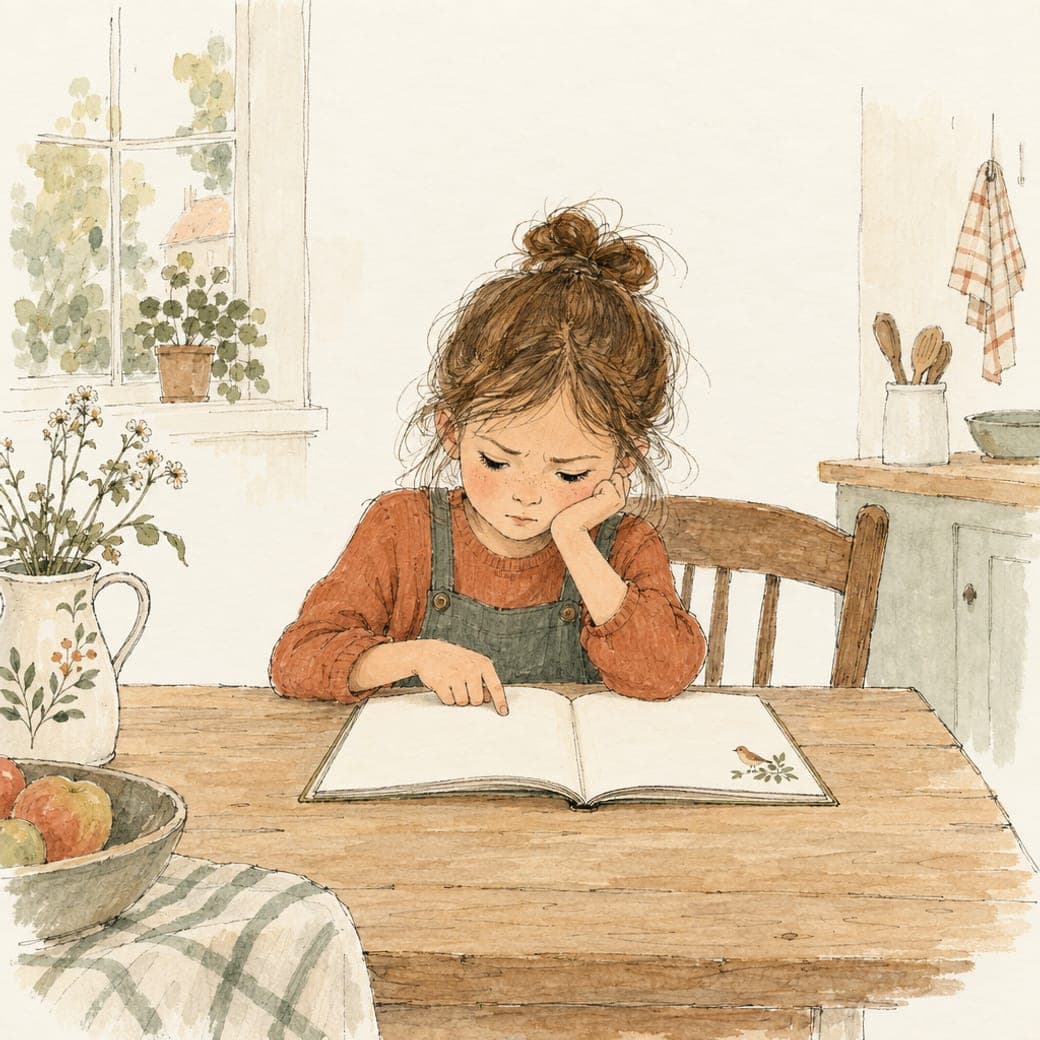
Illustration style: fine pen From sounding out to reading
In England, children in Year 1, aged five to six, take the phonics screening check: they read 20 real words and 20 pseudo-words aloud to a teacher. Pseudo-words show whether a child can really sound out, since they can't have learnt them by heart.7 In 2022, 75% met the expected standard, compared with 82% in 2019.8
The first chapter books are rated for this age. Common Sense Media gives Magic Tree House and Junie B. Jones “age 6+”, and Charlotte's Web “age 7+”.141516
A classic for this age
To read together
The American Academy of Pediatrics recommends “Brush, Book, Bed” as an evening routine: brushing teeth, a book, and a fixed bedtime.17 It still fits when a child can read a little on their own.
- 8-10 years
Learning to read, then reading to learn
Longer series take over. Common Sense Media rates the first Diary of a Wimpy Kid “age 9+”.18 BookTrust gives The Brilliant World of Tom Gates an interest age of 9 to 11.19
How children read is changing too. A meta-analysis of 54 studies, with readers from primary school to adulthood, found better comprehension on paper than on screen, especially under time pressure and for information texts.20
A classic for this age
To read together
Reading aloud and reading alone now run side by side. A chapter each evening, read in turns, keeps longer books within reach.
- 10-12 years

Illustration style: graphic novel Where a love of reading is won or lost
Publishers and libraries now speak of nine and ten and up. Chicken House gives Inkheart as 9+, and the reviews of Ireland's public libraries put Marita Conlon-McKenna's Under the Hawthorn Tree at 10 to 12.2122
A classic for this age
To read together
Whether you still read together at this age depends on what your family wants. Some children who read alone happily still like to be read to.
Three questions without a complete answer
These questions come up often, and the sources we consulted answer them only in part. Here is how far they go, and where they stop.
At what age does a child read alone?
What we know
In England, the phonics screening check tests children in Year 1, aged five to six, on 20 real words and 20 pseudo-words. In 2022, 75% met the expected standard.78
What remains open
The check shows who reached a standard at one point in time. It doesn't show the spread of ages at which children read fluently. If you're looking for a month to compare your child against, you won't find it here.
Does starting school earlier mean reading earlier?
What we know
Starting ages differ: in Ireland a child can begin Junior Infants at four and must be in school by six9; in the United States the kindergarten cut-off date varies from state to state.10
What remains open
None of the sources we consulted compares reading outcomes by starting age. We therefore make no claim about whether an earlier or later start is better for reading.
How much reading aloud is enough?
What we know
A calculation from Ohio State University: with five books a day, a child hears around 1,483,300 words from books before the age of five; without reading aloud, around 4,662.13
What remains open
It's a calculation, not an observation of families, and it names no threshold. No study we found says how many books a day make the difference.
Where the experts disagree
Two debates parents come across every day, with both positions and the exact point where they part.
Screen or paper?
For paper
A meta-analysis of 54 studies and 171,055 participants found better comprehension on paper than on screen. The gap was larger under time pressure and for information texts.20
For caution
The same meta-analysis found no difference for stories, and its participants ranged from primary school to adulthood.20
Ask questions while you read?
For dialogic reading
When the adult asks questions and lets the child tell the story, the words the child uses grow, with an average effect of d = 0.59 across sixteen studies.6
Frequently asked questions
When should I start reading to my baby?
The American Academy of Pediatrics encourages shared reading from birth. In the first months, what your baby takes in is your voice and its melody; understanding that a picture stands for a thing comes later, and the psychologist Judy DeLoache's account gives no age for it.
My baby doesn't seem to listen when I read. Does that matter?
At first, a picture is still an object for a child: DeLoache describes nine-month-olds trying to put their mouths on a drawn bottle. Grabbing, chewing and turning pages are part of the discovery. Follow your baby's pace and look at what they look at.
What is the Year 1 phonics screening check?
A short check in England for children in Year 1, aged five to six. They read 20 real words and 20 pseudo-words aloud to a teacher. The pseudo-words show whether a child can sound out a word they've never seen. In 2022, 75% of pupils met the expected standard, compared with 82% in 2019.
At what age do children start school in Ireland?
A child must be at least four on 1 September of the year they start Junior Infants, and school is compulsory from six at the latest. Some schools decide for themselves whether they take four- or five-year-olds.
When do children start kindergarten in the United States?
It depends on the state. California, Florida, Texas, Georgia and Michigan use 1 September as the cut-off date, North Carolina, Massachusetts and Washington 31 August, Ohio, Kentucky and Indiana 1 August, and New Jersey and Colorado 1 October.
Should I keep reading aloud once my child can read?
Yes, if you both enjoy it. The American Academy of Pediatrics recommends “Brush, Book, Bed” as an evening routine, and books your child can't yet read alone are the ones that carry them forward. At some point, reading in turns is a good bridge.
Is reading on a screen worse than on paper?
For older readers, a meta-analysis of 54 studies found better comprehension on paper, especially under time pressure and for information texts, and no difference for stories. It says nothing about small children being read to.
A story in which your child is the hero
At Sagalino, it becomes a picture book with your child's name, in the illustration style you choose. You read the whole story for free before you decide.
Try it for freeSources
- 1.Judy S. DeLoache: Becoming Symbol-Minded, Association for Psychological Science.What it confirms: At nine months, children treat a drawn bottle as an object and try to put their mouths on it, confusing the picture with the thing it shows. The source gives no age for the later understanding of pictures as symbols.
- 2.Raikes et al. (2006): Mother-Child Bookreading in Low-Income Families, Child Development.What it confirms: Among more than 2,500 low-income families in the US, shared reading is linked to the child's vocabulary from 14 months.
- 3.Bundeszentrale für gesundheitliche Aufklärung (BZgA): speaking and understanding in the first year, kindergesundheit-info.de.in GermanWhat it confirms: The language steps of the first year: reacting to how carers speak at around two months, cooing at two months, squeals and grunts at three, chains of syllables at five to six months, first words understood at around eight months.
- 4.Bundeszentrale für gesundheitliche Aufklärung (BZgA): language development, kindergesundheit-info.de.in GermanWhat it confirms: First words between 12 and 18 months, 50 to 200 words at 20 months, two- then three-word sentences, subordinate clauses at four to five, more than 3,000 words at school age, a passing stammer in the fourth year.
- 5.Zero to Three: 24 to 36 months, social and emotional development.What it confirms: Between 24 and 36 months, more complex feelings such as embarrassment and shame; two-year-olds show empathy and comfort crying peers.
- 6.Mol, Bus, de Jong and Smeets (2008): Added Value of Dialogic Parent-Child Book Readings, meta-analysis, Early Education and Development.What it confirms: Sixteen studies; an average effect of d = 0.59 on expressive vocabulary; a clearly smaller effect in children aged four to five and in children at risk.
- 7.Department for Education, Explore Education Statistics: Phonics screening check attainment, methodology.What it confirms: Pupils in Year 1, aged five to six, read 20 real words and 20 pseudo-words aloud.
- 8.Department for Education, Explore Education Statistics: Phonics screening check attainment, 2024/25.What it confirms: 75% of pupils met the expected standard in 2022, compared with 82% in 2019.
- 9.Citizens Information: Starting primary school.What it confirms: A child must be at least four on 1 September of the year of admission; school is compulsory from six at the latest; some schools decide whether they admit four- or five-year-olds.
- 10.World Population Review: Age to start kindergarten by state.What it confirms: Kindergarten cut-off dates by state: 1 September in California, Florida, Texas, Georgia and Michigan, 31 August in North Carolina, Massachusetts and Washington, 1 August in Ohio, Kentucky and Indiana, 1 October in New Jersey and Colorado.
- 11.Gaelscoileanna: Irish-medium education, facts and figures.What it confirms: In September 2023, 188 Gaelscoileanna at primary level with over 40,000 pupils outside the Gaeltacht; over 50,000 children on the island in Irish-medium education and over 13,000 in the Gaeltacht; ten such primary schools fifty years ago.
- 12.American Academy of Pediatrics: Early Literacy.What it confirms: Shared reading encouraged from birth and at least until kindergarten age.
- 13.Logan et al. (2019): When Children Are Not Read to at Home, Ohio State University, Journal of Developmental & Behavioral Pediatrics.What it confirms: By calculation, a child who is never read to hears around 4,662 words from books before the age of five; with five books a day, around 1,483,300.
- 14.Common Sense Media: Magic Tree House series, book review.What it confirms: The rating “age 6+”.
- 15.Common Sense Media: Junie B. Jones series, book review.What it confirms: The rating “age 6+”.
- 16.Common Sense Media: Charlotte's Web, book review.What it confirms: The rating “age 7+”.
- 17.American Academy of Pediatrics, HealthyChildren.org: Brush, Book, Bed.What it confirms: The evening routine of brushing teeth, a book and a fixed bedtime.
- 18.Common Sense Media: Diary of a Wimpy Kid, Book 1, book review.What it confirms: The rating “age 9+”.
- 19.BookTrust Bookfinder: The Brilliant World of Tom Gates.What it confirms: Interest age 9 to 11, reading age 9+.
- 20.Delgado, Vargas, Ackerman and Salmerón (2018): Don't throw away your printed books, meta-analysis, Educational Research Review.What it confirms: 54 studies and 171,055 participants; better comprehension on paper, especially under time pressure and for information texts; no difference for narrative texts; participants from primary school to adulthood.
- 21.Chicken House: Inkheart, Inkheart Trilogy Book 1.What it confirms: The age guidance 9+.
- 22.Libraries Ireland, Summer Stars: children's book review, Under the Hawthorn Tree.What it confirms: The age band 10 to 12.
- 23.Noble et al. (2019): meta-analysis on shared reading and children's language, Educational Research Review, vol. 28.What it confirms: A modest average effect of shared reading on language; the 2008 meta-analysis may overestimate effects.
Sources accessed on 26 September 2026. Is something missing or out of date? Write to us and we'll correct it, with the date.
Also worth reading
- Reading aloud to your childWhat reading aloud really does, and where the studies get thin.
- Bedtime stories for kidsThree free stories to read tonight, for ages 2, 4 and 6.
- The history of children's booksFrom Peter Rabbit to the Gruffalo, every date with its source.
- The illustration stylesWatercolour, collage, gouache, fine pen: the styles of the pictures on this page.