Illustration style
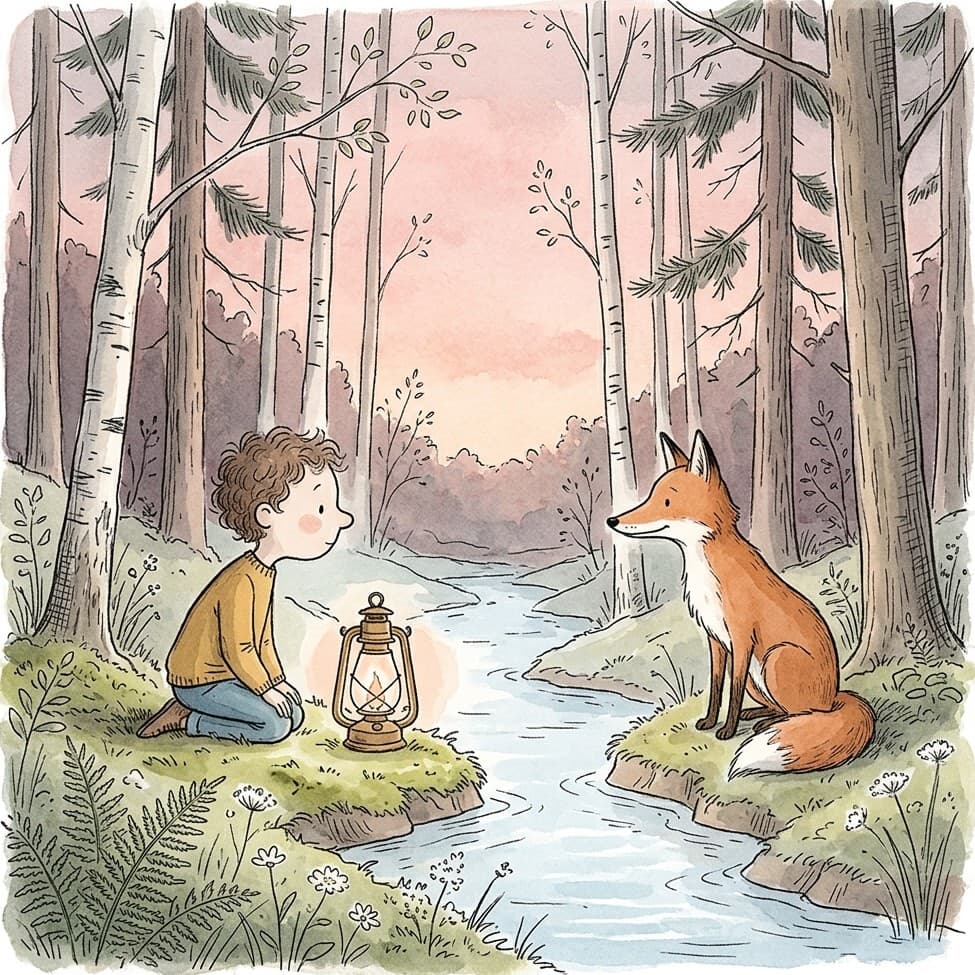
A fine pen children's book
Hardly any colour, just ink and paper. Whatever is missing, the line has to carry, and that's where you see whether a drawing holds up.
Read the whole story for freeThe same style throughout the bookeBook £4.50
What you can do without colour
One of the earliest lines begins in 1865 with Wilhelm Busch and Max und Moritz (Max and Moritz). The book pairs picture sequences with verse and is seen as a distant forerunner of the comic strip. For expression and movement, Busch relies on timing: each picture lands at exactly the right moment.
In England, E. H. Shepard carried the tradition forward. His illustrations for The Wind in the Willows in 1931 and Winnie-the-Pooh in 1926 were pure pen drawings, coloured decades later.
Tomi Ungerer, born in Strasbourg in 1931, took the pen in another direction: sharper, more political, often unsettling. In 1998 he received the Hans Christian Andersen Medal for illustration. His work shows that black and white is not harmless in a children's book.
Quentin Blake stands for the quick, deliberately imperfect pen; he received the Andersen Medal in 2002.
The technical heart stays the same: with no grey, every shade comes from hatching. Close lines darken, wide lines lighten. In our books black ink dominates; colour, where it appears, stays a pale wash.
The names behind it
Wilhelm Busch
Max und Moritz (Max and Moritz), 1865
Picture sequences in verse, a distant forerunner of the comic strip. Busch creates movement through the choice of moment alone.
E. H. Shepard
The Wind in the Willows, Methuen, 1931
Pure pen drawing. Shepard shows how much atmosphere you can create without a drop of colour.
Tomi Ungerer
Hans Christian Andersen Medal for illustration, 1998
Sharp, political, often unsettling. His work disproves the idea that black and white is safe in a children's book.
Quentin Blake
Hans Christian Andersen Medal for illustration, 2002
The quick, deliberately imperfect pen. His characters seem drawn mid-movement.
How do you recognise a pen drawing?
- Black ink dominates; colour, if there is any, stays pale and transparent.
- Shades come from hatching and cross-hatching.
- The thickness of the line varies, because the nib spreads when you press.
- Plenty of paper left white, which the eye reads as light.
- A visible stroke: you can see which way the drawing was made.
Which stories the pen suits
The pen is strong for humour and timing: mischief, mishaps, characters full of quirks. It's also the best choice for older children who find picture books too babyish, because an ink drawing looks more grown-up.
It suits worlds where everything happens through colour poorly. A book about the seasons needs colour; watercolour or gouache suit it better.
In terms of age, it suits children from about five and stays with them until well into primary school, sometimes beyond.
Good to know
Isn't a drawing with hardly any colour boring for a child?
For a two-year-old, probably; from about five, not at all. Without colour you have to look more closely, and many older children like exactly that, because it looks less like a baby book.
From what age does this style suit?
From about five. It stays with the child throughout primary school and suits those who find classic picture books too childish.
Will my child be recognisable in this style?
Very much so. The line renders the features and expressions precisely, because no colour does the work in its place.
Does the style stay the same throughout the book?
Yes. All 14 double pages are illustrated in the style you choose, and so are the cover and the character's portrait.
- 1.Wilhelm Busch, Max und Moritz, overview. (in German)What it confirms: First published in 1865, picture sequences in verse, forerunner of the comic strip.
- 2.Victoria and Albert Museum, collection: Winnie-the-Pooh, drawing by E. H. Shepard, 1926.What it confirms: Shepard's illustrations were originally pure pen drawings.
- 3.IBBY: Hans Christian Andersen Awards, winners.What it confirms: Tomi Ungerer received the medal for illustration in 1998, Quentin Blake in 2002.
- 4.Tomi Ungerer, overview. (in French)What it confirms: Born in Strasbourg on 28 November 1931.
The other styles
- 3D animation
- Andean textile art
- Art Nouveau
- Chinese ink
- Coloured pencil
- Cordel woodcut
- Graphic and simple
- Graphic novel
- Ink and watercolour
- Ligne claire
- Minhwa world
- Nordic fairy tale
- Paper collage
- Retro gouache
- Risograph
- Silhouettes
- Tingatinga world
- Ukiyo-e inspired
- Watercolour
- Wax crayon
At a glance: all illustration styles, how it works, frequently asked questions, the book without a photo, reading the story before you buy and the AI children's book.