Illustration style
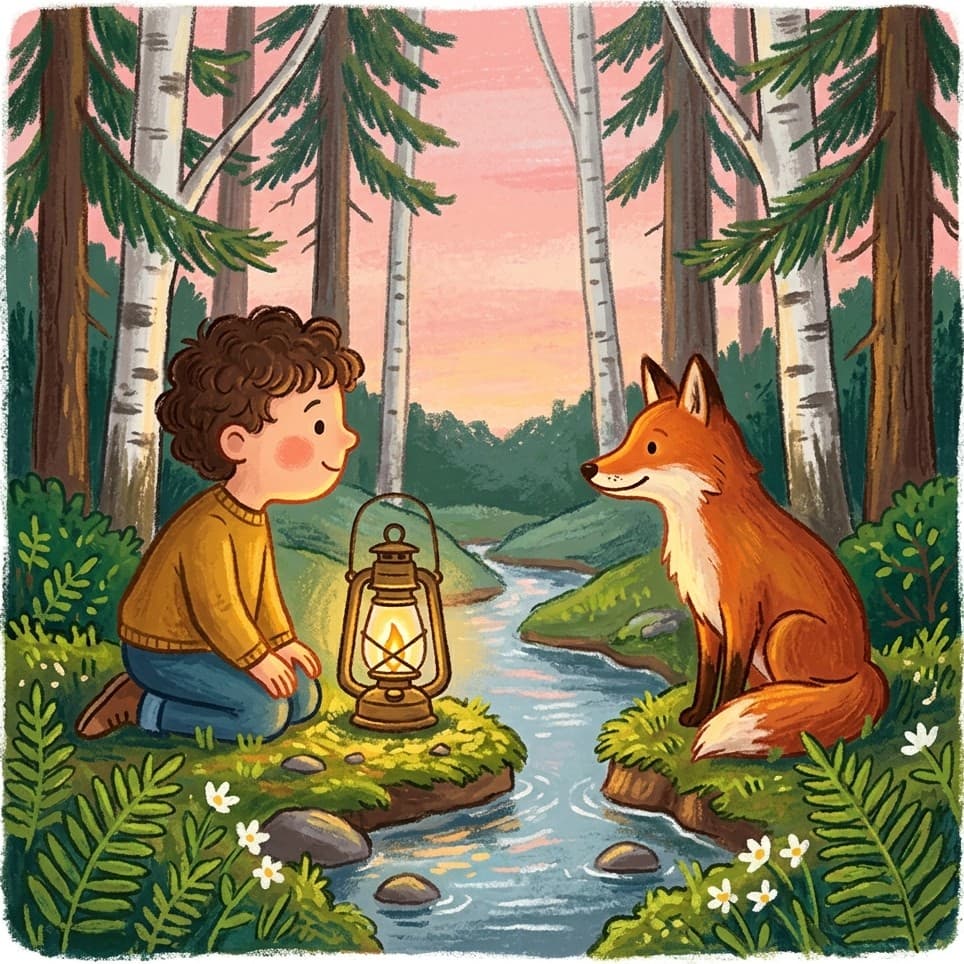
A wax crayon and oil pastel children's book
The colour sits on the paper rather than in it. You see every stroke, and the grain of the paper joins in.
Read the whole story for freeThe same style throughout the bookeBook £4.50
Wax, oil, and what that changes in the picture
For this style it helps to look at the material, because two related things are often confused.
Wax crayon is pigment held in a binder of pure wax, usually paraffin, without oil. It stays put without fixative and has a property no other medium has: wax repels water. If you paint watercolour over a wax drawing, the paint beads up on the waxed parts. This is called wax resist, and it's one of the few effects children understand straight away.
Oil pastel has a binder of wax and non-drying oil. It's creamier, covers more, can be layered and blended, and never dries completely. An analysis of artists' crayons held at the MUNCH museum in Oslo confirmed this difference chemically: oil pastels contain triglycerides as well as beeswax.
A gap needs mentioning here. For pure wax crayon, the picture book has no benchmark name we could cite with a work, a date and a source. Oil pastel is well documented, and it leads to Chris Van Allsburg. The University of Minnesota Libraries explicitly name oil pastel for his book Bad Day at Riverbend, published in 1995. For The Polar Express, published in 1985, the American Library Association also mentions oil pastel in the announcement of its Caldecott Medal, while other accounts speak of pastel pencils. We give both rather than choosing one without a primary source.
The names behind it
Chris Van Allsburg
Bad Day at Riverbend, Houghton Mifflin, 1995
Explicitly documented as oil pastel by the University of Minnesota Libraries. The best-established case of this technique in the picture book.
Chris Van Allsburg
The Polar Express, Houghton Mifflin, Caldecott Medal 1986, 1985
The American Library Association mentions oil pastel in the award announcement. Other accounts speak of pastel pencils; we have no primary source on this.
How do you recognise wax crayon and oil pastel?
- The colour visibly sits on the paper, with a slight relief.
- The grain of the paper shows through, because the crayon only touches its raised parts.
- Edges are broad and blunt, fine details almost impossible.
- Colours layer and blend without really mixing.
- Where watercolour meets wax, it beads up and lets the drawing show through.
Which stories crayon suits
Crayon is the warmest of the styles and suits stories you want to touch: mud, snow, autumn leaves, furry animals, everything with texture.
It also suits the very youngest, because the shapes are big and the colours bold. It works from about two.
For fine expressions and small details it's the weakest choice: a face stays simple. If a likeness of the face matters to you, choose watercolour or ink and watercolour.
Good to know
What's the difference between wax crayon and oil pastel?
Wax crayon has only wax as a binder; oil pastel also contains an oil that doesn't dry. In practice, wax crayon is more matt and streaky and repels watercolour; oil pastel is creamier, covers more and blends with a finger.
Will my child be recognisable in this style?
Well, by the hair colour, hairstyle, clothes and outline; the fine features of the face only partly. That's down to the technique: a crayon doesn't draw fine lines. If the face matters a lot to you, watercolour or ink and watercolour suit better.
From what age does this style suit?
From about two. The big shapes and bold colours are easy to read, and little ones know the technique from their own crayons.
Does the style stay the same throughout the book?
Yes. All 14 double pages are illustrated in the style you choose, and so are the cover and the character's portrait.
- 1.Harn Museum of Art: Watercolor Resist Painting.What it confirms: Wax repels water: watercolour beads up on the waxed parts.
- 2.Tate: Art Term Pastel.What it confirms: Oil pastel has a binder of wax and oil and so behaves differently from soft pastel.
- 3.Analytical study of crayons from the materials collection of the MUNCH museum, Oslo.What it confirms: Oil pastels are defined by a binder of beeswax mixed with triglycerides, unlike pure wax crayons.
- 4.University of Minnesota Libraries, Children's Book Art: Chris Van Allsburg.What it confirms: Bad Day at Riverbend (1995) is explicitly given as oil pastel.
- 5.American Library Association: The Polar Express, Caldecott Medal.What it confirms: The award announcement mentions oil pastel. Other accounts speak of pastel pencils.
The other styles
- 3D animation
- Andean textile art
- Art Nouveau
- Chinese ink
- Coloured pencil
- Cordel woodcut
- Fine pen
- Graphic and simple
- Graphic novel
- Ink and watercolour
- Ligne claire
- Minhwa world
- Nordic fairy tale
- Paper collage
- Retro gouache
- Risograph
- Silhouettes
- Tingatinga world
- Ukiyo-e inspired
- Watercolour
At a glance: all illustration styles, how it works, frequently asked questions, the book without a photo, reading the story before you buy and the AI children's book.