Illustration style
A coloured pencil children's book
A child who draws holds a coloured pencil. No other style is as close to what happens at home, at the kitchen table.
Read the whole story for freeThe same style throughout the bookeBook £4.50
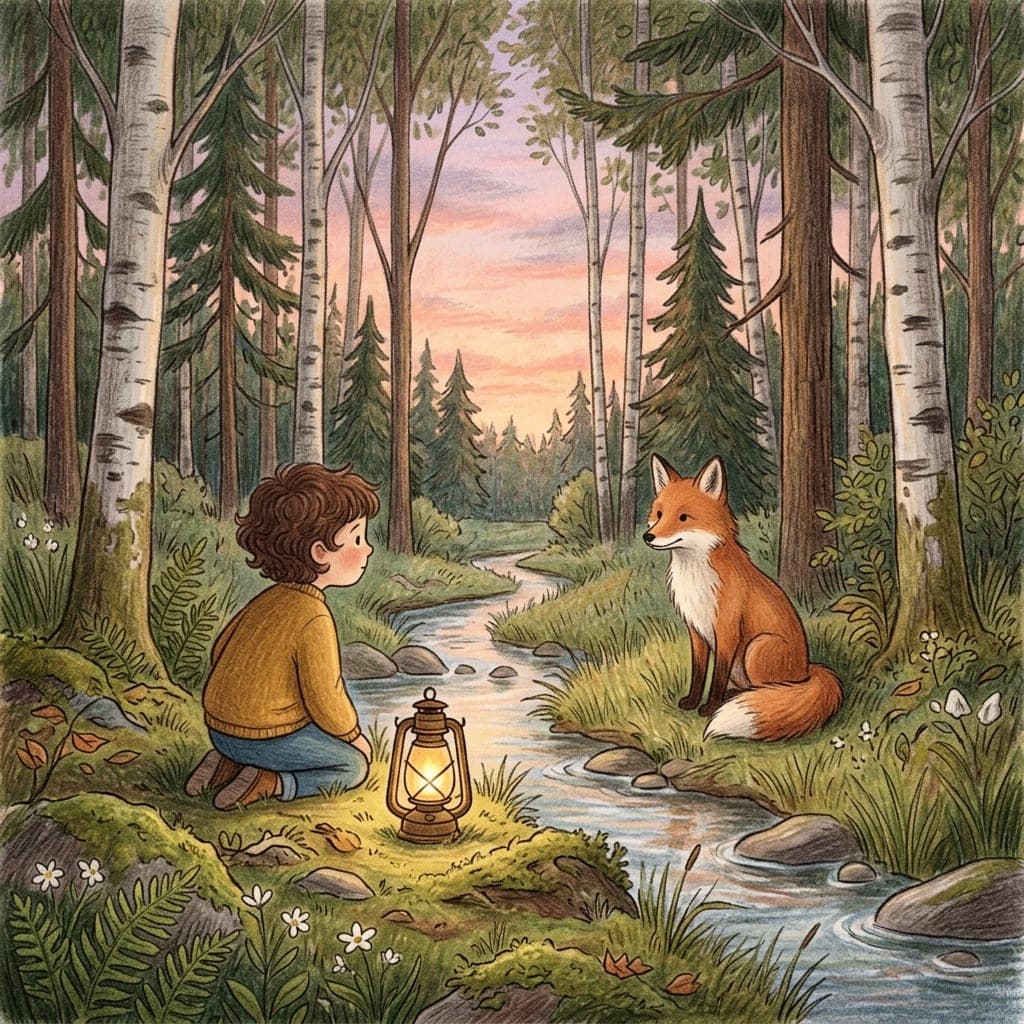
The technique children use themselves
Coloured pencil works differently from any paint: colour is built up in successive layers. Each layer stays visible as a stroke, and the mixtures happen in the eye of the person looking. That's why a coloured pencil picture never looks quite closed, even when the colours are dense.
In the German-language picture book, Nikolaus Heidelbach embodies this technique. In 2000 he received the Deutscher Jugendliteraturpreis, the major German prize for children's literature, in the picture-book category, for Was machen die Mädchen? (literally “What do the girls do?”). His pictures are drawn calmly and are often unsettling underneath, which is rare for a children's book.
Rotraut Susanne Berner works in a related vein and received the Hans Christian Andersen Medal for illustration in 2016. In her large wordless picture books, every character follows its own little story from page to page.
This style is not the same as a child's scribble: here an adult illustrator uses a technique children know well.
The names behind it
Nikolaus Heidelbach
Was machen die Mädchen?, Deutscher Jugendliteraturpreis, picture-book category, 2000
He shows that coloured pencil is not harmless. His pictures are calmly drawn and often unsettling underneath.
Rotraut Susanne Berner
Hans Christian Andersen Medal for illustration, 2016
Her large picture books tell several stories at once across the pages, without a single sentence of text.
How do you recognise coloured pencil?
- Visible strokes, even in areas that look solid.
- Mixtures made by layering, never on a palette.
- The grain of the paper stays visible in the areas of colour.
- No shine, no thickness of paint: everything stays flat on the sheet.
- Edges that often blur a little, because the stroke doesn't stop exactly at the outline.
Which stories coloured pencil suits
Coloured pencil suits everyday stories: school, family, falling out and making up, first times. Its restraint takes the pomp out of big subjects.
That makes it useful for difficult subjects too, like goodbyes or fear. A coloured pencil picture doesn't push itself forward.
For big, spectacular scenes it's too quiet. For space, dragons or a chase, gouache or ligne claire work better. In terms of age, coloured pencil suits children from about three.
Good to know
Will the book look as if a child drew it?
No. The pictures are carefully built up, with a tool children hold themselves. Coloured pencil is an illustration technique in its own right.
Will my child be recognisable in this style?
Yes. The stroke carries the features and the hairstyle, and expressions can be finely shaded. You describe the hair colour, eyes, glasses and favourite outfit.
From what age does the coloured pencil style suit?
From about three. For the very youngest, flat-colour styles are easier to read; from three, the kinship with their own way of drawing becomes an advantage.
Does the style stay the same throughout the book?
Yes. All 14 double pages are illustrated in the style you choose, and so are the cover and the character's portrait.
- 1.Arbeitskreis für Jugendliteratur: Deutscher Jugendliteraturpreis, winners 2000. (in German)What it confirms: Nikolaus Heidelbach received the Deutscher Jugendliteraturpreis in the picture-book category in 2000.
- 2.IBBY: Hans Christian Andersen Awards, winners.What it confirms: Rotraut Susanne Berner received the medal for illustration in 2016.
The other styles
- 3D animation
- Andean textile art
- Art Nouveau
- Chinese ink
- Cordel woodcut
- Fine pen
- Graphic and simple
- Graphic novel
- Ink and watercolour
- Ligne claire
- Minhwa world
- Nordic fairy tale
- Paper collage
- Retro gouache
- Risograph
- Silhouettes
- Tingatinga world
- Ukiyo-e inspired
- Watercolour
- Wax crayon
At a glance: all illustration styles, how it works, frequently asked questions, the book without a photo, reading the story before you buy and the AI children's book.