Illustration style
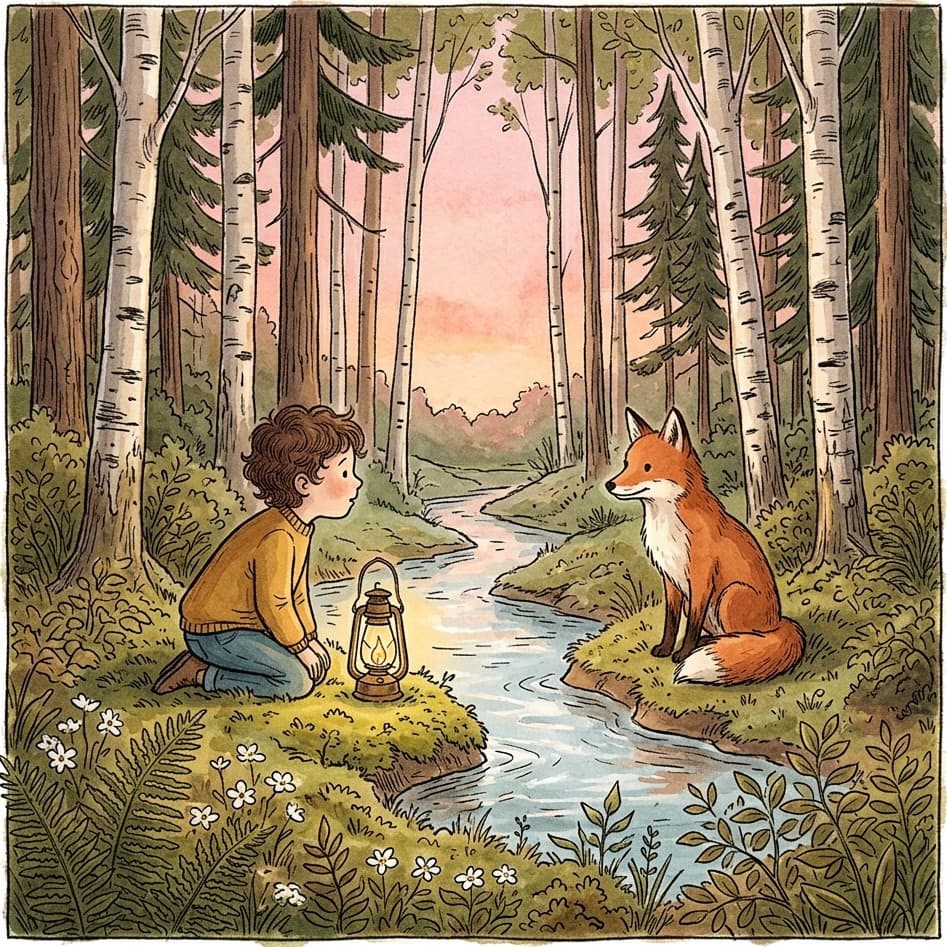
An ink and watercolour children's book
The line first, then the colour. One of the oldest pairings in the picture book, and the one that best hides how hard it is.
Read the whole story for freeThe same style throughout the bookeBook £4.50
The line comes first
It's the order that makes the style: the pen and ink drawing is finished on the paper, then the colour goes on top, transparently. The line stays visible and carries the whole shape. The colour is added to it.
With E. H. Shepard you can follow it closely. His illustrations for Winnie-the-Pooh in 1926 were pure ink drawings; the coloured versions came decades later. Anyone who knows the first editions knows this style in its purest form.
Quentin Blake pushed the line in the opposite direction: jittery, fast, deliberately imperfect. For Roald Dahl's books that was exactly right, because Dahl's characters are anything but nice. In 2002, Blake received the Hans Christian Andersen Medal for illustration.
The Swede Sven Nordqvist, with Pettson and Findus, stands for the teeming version, and the German Jutta Bauer for the pared-down one. Jutta Bauer received the Andersen Medal in 2010.
The names behind it
E. H. Shepard
Winnie-the-Pooh, Methuen, 1926
The original illustrations of 1926 were pure pen drawings. The coloured versions came decades later.
Quentin Blake
Hans Christian Andersen Medal for illustration, 2002
His quick, deliberately imperfect line shaped Roald Dahl's books. He shows that a drawing can work without being neat.
Sven Nordqvist
Pettson and Findus, first volume published in Sweden, 1984
The teeming version: in every picture more happens at the edges than in the middle. Children find something new every time they read it.
Jutta Bauer
Hans Christian Andersen Medal for illustration, 2010
The opposite of Nordqvist. A few lines are enough for her to catch emotions that take others a whole page.
How do you recognise ink and watercolour?
- A continuous, clearly visible outline that carries the shape.
- A line of varying thickness, because the nib spreads when you press.
- Hatching instead of grey, where the picture needs to get darker.
- Colour laid under the line, which lets it show through.
- Areas of colour that sometimes deliberately spill over the outline.
Which stories ink and watercolour suit
Because the line carries everything, this style is strong for action and characters: adventure, friendship, everyday comedy, characters full of quirks. Expressions work better here than in almost any other style, because a single line is enough to raise an eyebrow.
It suits mood pictures without action less well. A sunset lives mostly from its colour; there, watercolour on its own is a better choice.
In terms of age, it suits children from about three and stays with them into primary school.
Good to know
Is this the Winnie-the-Pooh style?
It's the same technique: the pen drawing first, the colour afterwards. E. H. Shepard's originals of 1926 were even pure ink drawings, coloured decades later. We use this visual language without copying any particular book.
Will my child be recognisable in this style?
Yes, very. The line carries the features and the expressions, and that's where this style outdoes every flat-colour style.
From what age does this style suit?
From about three. For the very youngest, styles with large shapes such as collage are easier to read; from three, the line becomes an advantage, because it tells details.
Does the style stay the same throughout the book?
Yes. All 14 double pages are illustrated in the style you choose, and so are the cover and the character's portrait.
- 1.Victoria and Albert Museum, collection: Winnie-the-Pooh, drawing by E. H. Shepard, 1926.What it confirms: Shepard's original illustrations of 1926 were ink drawings.
- 2.IBBY: Hans Christian Andersen Awards, winners.What it confirms: Quentin Blake received the medal for illustration in 2002, Jutta Bauer in 2010.
- 3.Sven Nordqvist, overview of his work. (in German)What it confirms: First volume of Pettson and Findus in 1984, in Sweden.
The other styles
- 3D animation
- Andean textile art
- Art Nouveau
- Chinese ink
- Coloured pencil
- Cordel woodcut
- Fine pen
- Graphic and simple
- Graphic novel
- Ligne claire
- Minhwa world
- Nordic fairy tale
- Paper collage
- Retro gouache
- Risograph
- Silhouettes
- Tingatinga world
- Ukiyo-e inspired
- Watercolour
- Wax crayon
At a glance: all illustration styles, how it works, frequently asked questions, the book without a photo, reading the story before you buy and the AI children's book.