Illustration style
A children's book in the Nordic fairy tale style
A dark forest, a small figure, plenty of space in between. For over a hundred years, Nordic picture-making has dared to show children serious things.
Read the whole story for freeThe same style throughout the bookeBook £4.50
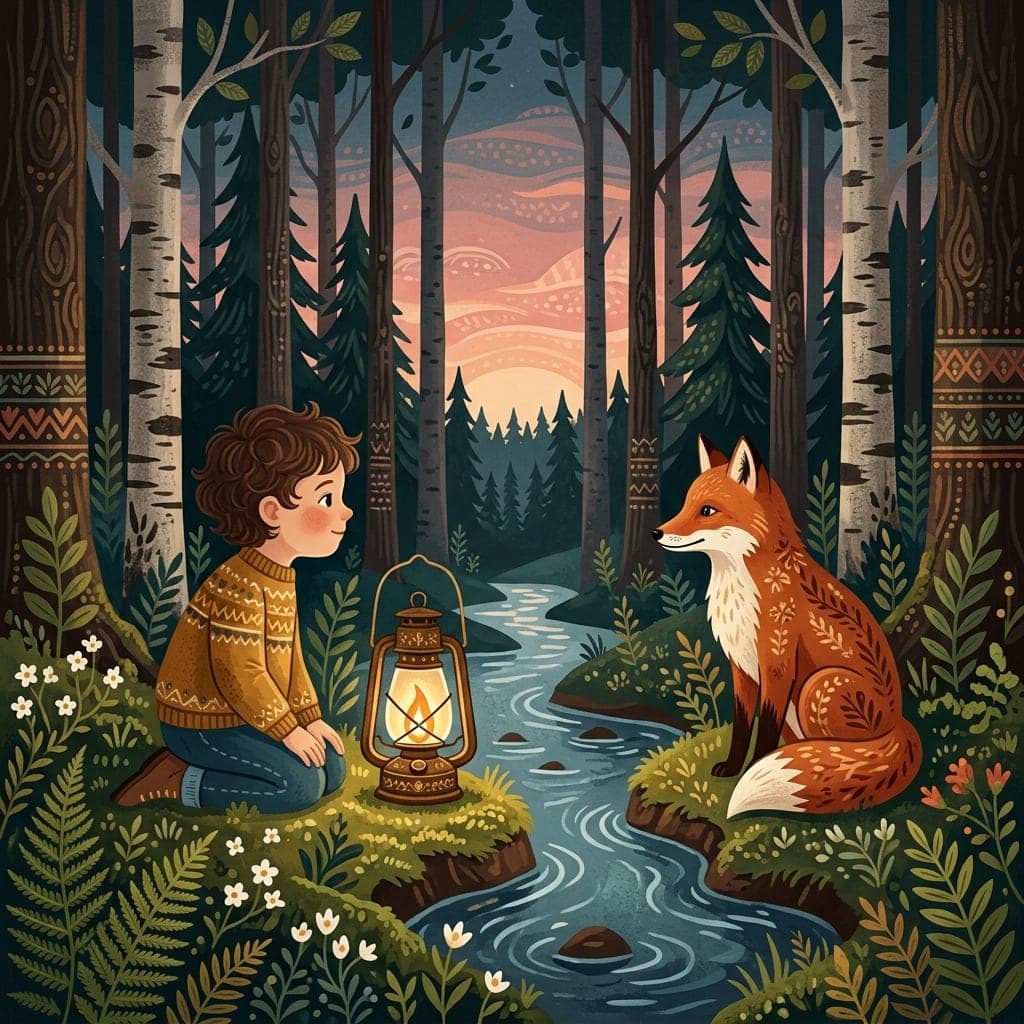
The forest where something is waiting
The tradition begins in 1907 with John Bauer and the Swedish fairy-tale annual Bland tomtar och troll (literally “Among gnomes and trolls”). It sold around 100,000 copies, a huge figure for the time. Bauer's trolls aren't cute, his forests aren't cosy, and yet these books were meant for children.
Elsa Beskow stands for the friendlier side of the same tradition. Her books explain the seasons and plants without taking away nature's seriousness.
Ilon Wikland illustrated Astrid Lindgren's books for decades, including The Brothers Lionheart in 1973 and Ronia, the Robber's Daughter in 1981. She grew up in Estonia and fled to Sweden in 1944, and her landscapes carry that.
What these pictures share is an attitude: lots of landscape, little figure, soft light, and the trust that children can bear a little unease.
The names behind it
John Bauer
Bland tomtar och troll, Swedish fairy-tale annual, 1907
It sold around 100,000 copies and still shapes the image of the Nordic fairy-tale forest today. His trolls are deliberately not cute.
Elsa Beskow
Picture books about plants and the seasons, Sweden, 1897
The friendly side of the same tradition. Beskow brings children closer to nature without sweetening it.
Ilon Wikland
Illustrations for Astrid Lindgren's The Brothers Lionheart, 1973
Astrid Lindgren's illustrator for decades, up to Ronia, the Robber's Daughter in 1981.
Gustaf Tenggren
Took over illustrating Bland tomtar och troll from 1917, 1917
He carried Bauer's world forward and later took it to the United States, where it lived on through Disney and the Little Golden Books.
How do you recognise the Nordic style?
- The landscape takes up more room than the figure.
- Muted colours: moss green, blue-grey, earth tones, rarely bright colours.
- Twilight rather than midday sun.
- Large calm areas where little happens.
- A mood between reassuring and unsettling that doesn't come down on either side.
Which stories the Nordic style suits
This style carries serious stories: courage, goodbyes, loneliness, experiences in nature, everything that isn't only funny. It sweetens nothing, and that's what makes it valuable for difficult subjects.
For everyday comedy it's too heavy. A book about the first day at nursery would take on a weight it doesn't need.
In terms of age, it suits children from about four, because younger ones find the small figure in the big landscape less easily.
Good to know
Isn't this style too dark for children?
It's serious at times. For more than a hundred years, the Nordic picture-book tradition has trusted children: a forest can be unsettling too. For a story about courage or saying goodbye, that's a strength; for a cheerful everyday story, a brighter style suits better.
From what age does the Nordic style suit?
From about four. Because the figure is small and the landscape big, younger children take longer to find the hero.
Will my child be recognisable in this style?
Very much so, by the hairstyle, the clothes and the way they carry themselves. In this tradition faces stay understated, because the mood of the picture takes the lead. For strong expressions, ink and watercolour or watercolour suit better.
Does the style stay the same throughout the book?
Yes. All 14 double pages are illustrated in the style you choose, and so are the cover and the character's portrait.
- 1.John Bauer, overview of his work.What it confirms: Bland tomtar och troll from 1907, around 100,000 copies; Gustaf Tenggren took over the series from 1917.
- 2.Ilon Wikland, overview of her work. (in German)What it confirms: Astrid Lindgren's illustrator for many years, including The Brothers Lionheart (1973) and Ronia, the Robber's Daughter (1981).
- 3.Elsa Beskow, overview of her work. (in German)What it confirms: First picture books from 1897, which shaped the Swedish picture-book tradition.
The other styles
- 3D animation
- Andean textile art
- Art Nouveau
- Chinese ink
- Coloured pencil
- Cordel woodcut
- Fine pen
- Graphic and simple
- Graphic novel
- Ink and watercolour
- Ligne claire
- Minhwa world
- Paper collage
- Retro gouache
- Risograph
- Silhouettes
- Tingatinga world
- Ukiyo-e inspired
- Watercolour
- Wax crayon
At a glance: all illustration styles, how it works, frequently asked questions, the book without a photo, reading the story before you buy and the AI children's book.