Illustration style
A children's book with patterns of Andean textile art
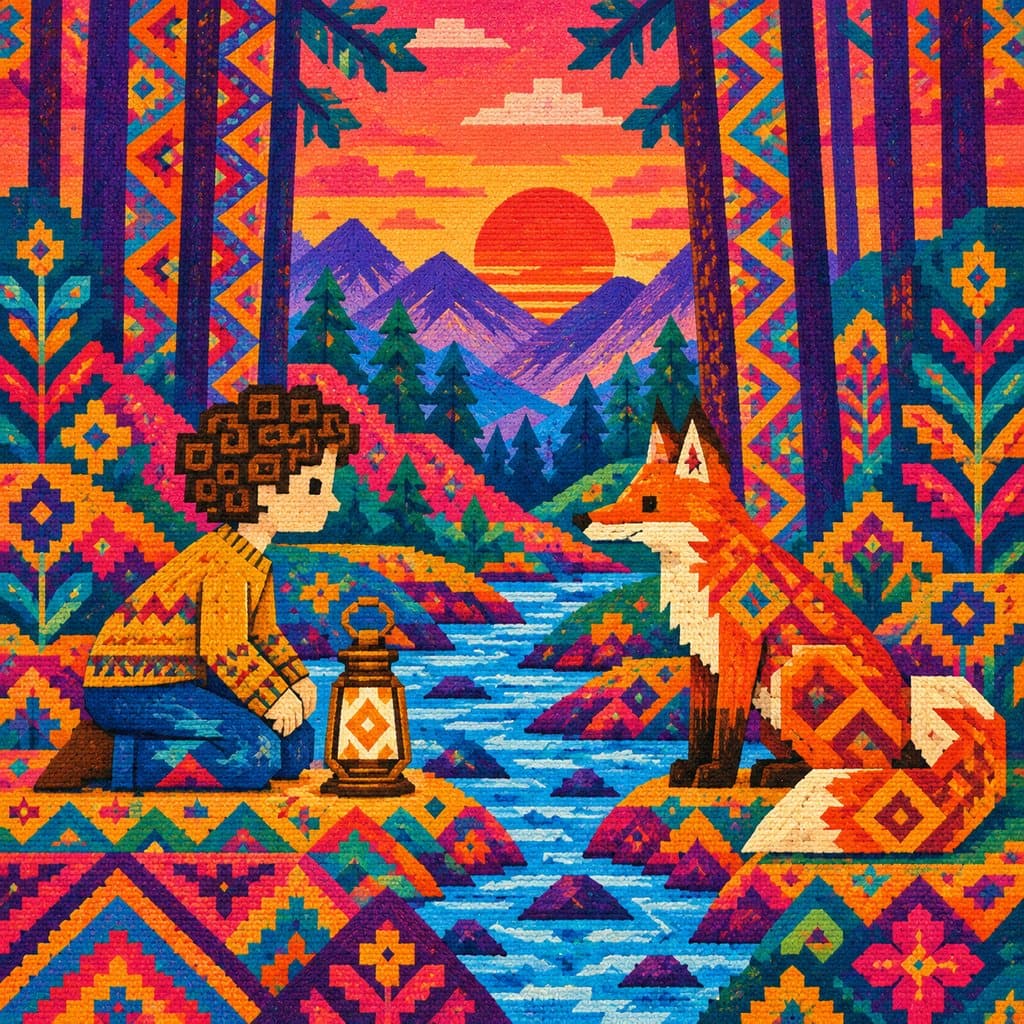
This style is a present-day illustration inspired by the colours and geometric patterns of Andean textile art. It does not belong to any historical children's book tradition. The textile traditions it refers to are far older and stand in their own right.
Read the whole story for freeThe same style throughout the bookeBook £4.50
Weaving in the Andes: many cultures, an art thousands of years old
“Andean textile art” does not mean a single tradition. The Andean region comprises many cultures, and according to the Metropolitan Museum of Art, weaving there is among the oldest and most varied art forms, long before the Inca empire, which lasted from about 1470 to 1532. Important textile holdings come, among others, from the Paracas (about 800 to 100 BC), the Nasca (about AD 100 to 700), the Wari (about AD 600 to 1000) and the Inca. The names of the weavers who made these early pieces have mostly not been handed down.
Textiles in the Andes were more than decoration. Because the early cultures had no writing, they contributed substantially, according to the Met, to passing on information as well as social and political messages. A Wari tunic counted among the most important signs of belonging, and fine Inca garments were reserved for the emperor, the nobility and persons he had given them to. Weavers in the Cusco region today take landscape, sky and the life of the community, among other things, into their patterns.
The basis of this visual language is the craft: dyed fibres, spun yarn and various weave structures. The backstrap loom, on which the weaver regulates the tension of the warp threads with her own body, has been in use since at least 1500 BC according to the Met and is still used in the Cusco region today. Because every fabric arises from vertical and horizontal threads, geometric forms such as diamonds, zigzags and stepped wave patterns result to a good extent from the material itself.
Weaving continued after the Spanish conquest in the sixteenth century, especially in the southern highlands of Peru and Bolivia. The Centro de Textiles Tradicionales del Cusco was founded in 1996 by weavers from Chinchero and their supporters. It works with ten weaving communities of the region and helps to preserve and revive techniques, natural dyes and patterns.
Our pictures are a free adaptation. They do not reproduce textiles and do not reconstruct a tradition. They take up colours, zigzag borders, stepped diamonds and the staircase-shaped edges of the weaving grid and place them in a present-day children's book scene. Forest, fox and river belong to the child's story and not to any particular textile tradition. Which community a pattern belongs to and what it means, the pictures do not reproduce.
The names behind it
Weavers of the Paracas culture (names not handed down)
Border fragment with figures carrying staffs, Cerro Colorado
They embroidered colourful animals, plants and figures on cloth and mirrored a motif in changing colours, a technique that continued for about a thousand years.
Weavers of the Wari culture (names not handed down)
Tunic, Peru, seventh to ninth century
Their tunics of dyed camelid wool show rich colours, interlocking forms and mirrored repetitions, in part built around a wave-shaped stepped pattern.
Nilda Callañaupa Alvarez
Founding of the Centro de Textiles Tradicionales del Cusco, 1996
The Quechua weaver from Chinchero has led the centre since its founding and stands for the living tradition that passes on techniques and patterns today.
Anni Albers
Pasture, 1958
She does not belong to the Andean tradition but studied Andean textiles, collected fragments and took their design principles into modern textile art.
How do you recognise the picture?
- Areas that look woven or embroidered, with visible thread structure instead of smooth colour gradients.
- Staircase-shaped, pixel-like edges: curves are built from small steps, as the weaving grid dictates.
- Borders and fillings of zigzag, stepped diamonds, angular bands and stylised plants.
- Rich colours set side by side, such as magenta, orange, turquoise, violet, golden yellow and deep blue.
- Figures made of a few block shapes, whose clothing and fur carry patterns while faces stay plain.
Which stories this style suits
The style suits stories with a lot of nature, animals, journeys and landscape, because mountains, rivers and forests can be translated into areas of pattern. If you look at a picture for a long time and search for small things, you will find plenty here: a fox whose fur is made of diamonds, or a river of horizontal rows of thread, invite discovery.
It is less suited to very quiet stories that need calm and empty areas, or to scenes where fine facial expressions matter, because figures are built from block shapes. In terms of age, it suits children from about four years, when they enjoy searching for and naming patterns.
Anyone interested in a particular textile tradition will find no reproduction in our pictures. They see themselves as inspired by Andean textile art: present-day children's book illustration with patterns and colours modelled on the Andean region.
Good to know
Is this real Andean textile art?
No. The pictures are inspired by Andean textile art. They take over colours, zigzags, diamonds and the stepped edge form of the weave, but do not reproduce any particular textile or tradition. The scenes themselves, forest, fox and river for example, come from your story.
Which culture do the patterns come from?
From no single one. The Andean region comprises many cultures with their own traditions, such as Paracas, Nasca, Wari and Inca, and patterns there can stand for belonging or landscape. We use general forms such as zigzags and diamonds and do not attribute to them the meaning of any particular community.
From what age does this style suit?
From about four years. The dense patterns offer a lot to discover. For very young children the picture can seem busy, because only a few areas stay free.
Where can I learn more about the real textile traditions?
In the bulletin for the exhibition “Weaving Abstraction in Ancient and Modern Art”, the Metropolitan Museum of Art presents textiles from the Andes. The Centro de Textiles Tradicionales del Cusco in Peru works with weaving communities and gives an insight into the craft today.
Does the style stay the same throughout the book?
Yes. All 14 double pages are illustrated in the style you choose, and so are the cover and the character's portrait.
- 1.The Metropolitan Museum of Art: Weaving Abstraction in Ancient and Modern Art, Bulletin, Autumn 2023 (Candela, Pillsbury).What it confirms: Weaving as one of the oldest art forms of the Andes, the Paracas, Nasca, Wari and Inca cultures, the backstrap loom since at least 1500 BC, the weaving grid as the origin of geometric patterns, textiles as carriers of messages and belonging, continued weaving after the Spanish conquest, the founding of the Centro de Textiles Tradicionales del Cusco in 1996, Anni Albers and her study of Andean textiles.
- 2.Josef and Anni Albers Foundation: Weaving Abstraction in Ancient and Modern Art.What it confirms: Anni Albers was one of four modern women artists in the exhibition whose work was set alongside textiles from the Andes; Pasture was made in 1958.
- 3.Centro de Textiles Tradicionales del Cusco: Home page.What it confirms: Founding in 1996 by Andean weavers and their supporters, collaboration with ten weaving communities of the Cusco region, the aim of preserving textile traditions.
- 4.Centro de Textiles Tradicionales del Cusco: Backstrap Weaving Workshop.What it confirms: Weaving on the backstrap loom is taught and cultivated in the Cusco region today, guided by weavers from highland communities.
- 5.Smithsonian Folklife Festival: Master Workshop Backstrap Weaving with Nilda Callañaupa.What it confirms: Nilda Callañaupa Alvarez comes from Chinchero and co-founded the Centro de Textiles Tradicionales del Cusco; patterns on the backstrap loom take up landscape, sky and cultural life.
- 6.Textile Museum of Canada: Nilda, Weaver (Cloth & Clay).What it confirms: Nilda Callañaupa Alvarez grew up in Chinchero, learned spinning as a child and works at the backstrap loom; in 1996 she founded the Centro de Textiles Tradicionales del Cusco.
- 7.Wikipedia: Center for Traditional Textiles of Cusco.What it confirms: Founding in 1996 by weavers from Chinchero and supporters, led by Nilda Callañaupa Alvarez from the start, ten weaving communities, revival of plant-based natural dyes since 1999.
The other styles
- 3D animation
- Art Nouveau
- Chinese ink
- Coloured pencil
- Cordel woodcut
- Fine pen
- Graphic and simple
- Graphic novel
- Ink and watercolour
- Ligne claire
- Minhwa world
- Nordic fairy tale
- Paper collage
- Retro gouache
- Risograph
- Silhouettes
- Tingatinga world
- Ukiyo-e inspired
- Watercolour
- Wax crayon
At a glance: all illustration styles, how it works, frequently asked questions, the book without a photo, reading the story before you buy and the AI children's book.