Illustration style
A children's book in cordel woodcut
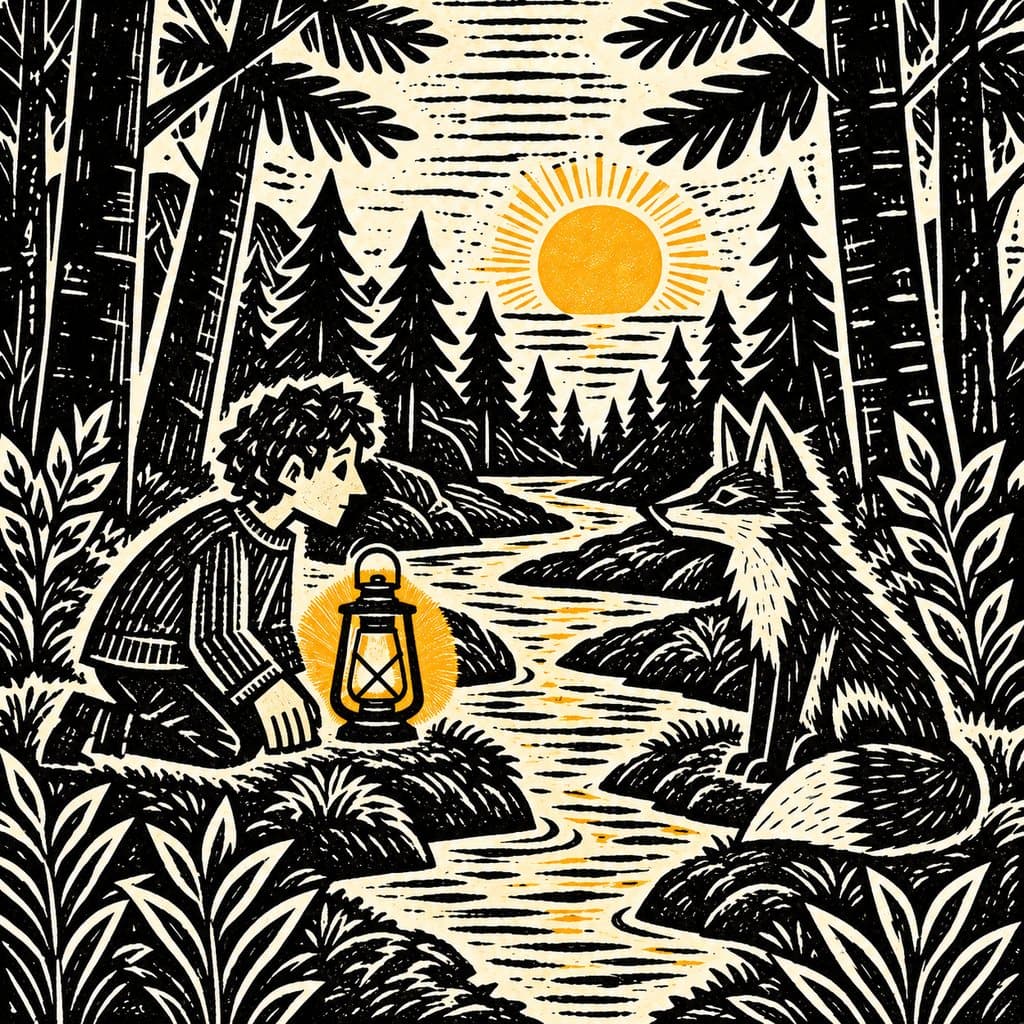
Black areas into which light lines are cut: fur, hair, water, branches. The style goes back to the woodcuts that appeared on the pamphlets of the Literatura de cordel from north-eastern Brazil. Our pictures are a present-day children's book interpretation of it.
Read the whole story for freeThe same style throughout the bookeBook £4.50
Verse stories inside, woodcut on the cover
Literatura de cordel means printed verse stories in small pamphlets. The name comes from Portugal, where such pamphlets were hung on strings at markets. In Brazil the tradition developed from the late nineteenth century, above all in the north-east. The poet Leandro Gomes de Barros (1865-1918) from Paraíba is regarded as a pioneer, and his pamphlet of 1893 is named as the oldest known Brazilian cordel pamphlet. In 2018 the National Institute of Historic and Artistic Heritage (Iphan) entered the Literatura de cordel as intangible cultural heritage, expressly including the woodcutters. The tradition is therefore still alive.
The woodcut was not on the pamphlets from the very beginning. Early editions mostly carried decorative borders or metal clichés that the print shops had to hand anyway. Here and there, woodblock clichés appeared from 1907. According to the Instituto Brasil Solidário, the distinctive woodcut art of the north-east developed from the 1940s onwards, because it offered a simple and cheap process for cover pictures. Many poets now cut their printing blocks themselves, in part with improvised tools.
The craft follows a clear logic: everything that is to stay light in the print is cut away from a block of wood. The raised areas left standing take up ink and are printed onto the paper. As many pamphlets as you like can be illustrated from one block. Typical, therefore, are simplified figures, strong contrasts of light and dark and cut marks that you can still see in the finished print. The covers are often printed in black on coloured paper.
From the 1960s this visual language also reached exhibitions, and from the 1970s galleries sold single sheets. The artists who made their own works from it include J. Borges and Gilvan Samico.
Our pictures carry this effect over into a present-day children's book illustration and do not reproduce any particular woodcut. Forest, fox and lantern are our choice of motif for the example picture, and the yellow accent for sun and lamplight is an addition of ours, not a feature of the tradition. Nothing is printed: the picture is made digitally and imitates the cut lines.
The names behind it
Leandro Gomes de Barros
First cordel pamphlets from 1893, among them O Boi Misterioso, 1893
The poet from Paraíba (1865-1918) is regarded as the father of the Literatura de cordel and as a pioneer who made writing and selling pamphlets a profession.
J. Borges (José Francisco Borges)
O Encontro de Dois Vaqueiros no Sertão de Petrolina
The poet and woodcutter from Bezerros, Pernambuco (1935-2024), had his first pamphlet illustrated by Mestre Dila and afterwards cut his blocks himself; his sheets were shown internationally.
Mestre Noza (Inocêncio Medeiros da Costa)
Album Via Sacra, 1965
The woodcutter from Juazeiro do Norte (1897-1983) made numerous cover pictures for cordel pamphlets; his album Via Sacra appeared in Paris in 1965.
Gilvan Samico
A Mãe dos Homens, 1981
The printmaker from Recife (1928-2013) made strictly composed woodcuts from north-eastern Brazilian legends, whose pictorial world recalls cordel covers.
How do you recognise a cordel woodcut?
- Black masses into which light lines are cut, visible within the figures too: in fur, in hair, in a jumper, on branches and leaves.
- Cut marks with slightly irregular edges. The lines taper to a point, as if drawn with a gouge.
- Only black on cream-coloured paper, without greys and without soft gradients.
- Areas such as water and sky arise from rows of horizontal cuts instead of colour.
- Figures are recognised by cut features: the shape of the hair, ears, a tail, patterns of clothing. The yellow accent for sun and lantern is an addition of ours.
Which stories this style suits
The cordel woodcut carries stories of forest, animals, night, journey and adventure. The strong areas give scenes tension, and because no skin or hair colour shows in black and white, figures are recognised by cut features: curly hair, pointed ears, a striped jumper, a lantern in the hand.
It differs from silhouettes in what happens inside. The silhouette lives on the outline, the woodcut on visible cut lines within the figures and areas. It is less suited to quiet bedtime stories and to scenes where fine facial features matter, because the dense cut structure looks busier than a smooth area.
As a rough guide, it suits children from about four to five years, when they like to look for a long time and search for details. That is an editorial judgement and not a rule: the strong black-and-white contrast is very appealing to some children and too much for others.
Good to know
Is this a real woodcut?
The pictures are made digitally and imitate the effect of a woodcut, without a printing block being cut. They are inspired by the woodcuts of the Brazilian cordel pamphlets and are a free adaptation into children's book illustration, not a reproduction of any particular original.
Do the motifs have to be Brazilian?
No. Your story determines the motifs. The example picture shows a forest with a fox and a lantern. What is taken over is the cutting technique, with its light lines in the black areas.
What is the difference from silhouettes?
Silhouettes work with outlines, that is, with the outer contour of a figure. In the woodcut, light cut lines stand inside the black areas, in fur or hair for example. The figure thus has a visible inner structure.
From what age does this style suit?
As a rough guide, from about four to five years. The strong contrast and dense cut structure invite long looking but can seem busy to very young children.
Does the style stay the same throughout the book?
Yes. All 14 double pages are illustrated in the style you choose, and so are the cover and the character's portrait.
- 1.Instituto Brasil Solidário: Xilogravura, Fascículo 4 of the series “Cordel na Escola”. (in Portuguese)What it confirms: Leandro Gomes de Barros (1865-1918) and his pamphlet of 1893, decorative borders and metal clichés on early covers, woodcut from the 1940s, J. Borges and Mestre Dila, exhibitions from the 1960s, Samico (1928-2013) and the Movimento Armorial.
- 2.Agência Brasil: Literatura de cordel é reconhecida como patrimônio cultural do Brasil, 2018. (in Portuguese)What it confirms: The entry of the Literatura de cordel as intangible cultural heritage by Iphan on 19 September 2018, with woodcutters among the bearers expressly named.
- 3.SESC São Paulo: Dos barbantes ao WhatsApp, 2018. (in Portuguese)What it confirms: Leandro Gomes de Barros as father of the Literatura de cordel, his first pamphlets from 1893 with the title O Boi Misterioso, the origin of the name in the strings on which the pamphlets were sold.
- 4.Prefeitura de São Paulo, Biblioteca Belmonte: Literatura de Cordel. (in Portuguese)What it confirms: Spread of the Literatura de cordel in the north-east, Leandro Gomes de Barros as patron, cover on coloured paper with a woodcut in black.
- 5.Prefeitura de São Paulo, Biblioteca Belmonte: Xilogravura na Biblioteca. (in Portuguese)What it confirms: The process: wood as printing block, worked with a cutting tool, the raised areas inked with a roller and printed onto paper.
- 6.Fundação Clóvis Salgado: A criatividade e as histórias populares nas xilogravuras de Gilvan Samico. (in Portuguese)What it confirms: Samico's woodcuts, in which parts that are not to take ink are removed, his themes from north-eastern Brazilian legends, the effect of the white areas, the invitation to the Movimento Armorial in 1971 and the work A Mãe dos Homens of 1981.
- 7.Diário de Pernambuco: Morre aos 88 anos o xilogravurista pernambucano J. Borges, July 2024. (in Portuguese)What it confirms: Life dates of J. Borges (20 December 1935 to 26 July 2024, Bezerros), his start as a cordel seller and author, the pamphlet O Encontro de Dois Vaqueiros no Sertão de Petrolina and the collaboration with Mestre Dila.
- 8.Blombo Art: Mestre Noza, Via Sacra.What it confirms: Mestre Noza, born in September 1897 in Taquaritinga do Norte, died on 21 December 1983 in São Paulo, cut cover pictures for cordel pamphlets; the album Via Sacra appeared in Paris in 1965.
The other styles
- 3D animation
- Andean textile art
- Art Nouveau
- Chinese ink
- Coloured pencil
- Fine pen
- Graphic and simple
- Graphic novel
- Ink and watercolour
- Ligne claire
- Minhwa world
- Nordic fairy tale
- Paper collage
- Retro gouache
- Risograph
- Silhouettes
- Tingatinga world
- Ukiyo-e inspired
- Watercolour
- Wax crayon
At a glance: all illustration styles, how it works, frequently asked questions, the book without a photo, reading the story before you buy and the AI children's book.