Illustration style
A graphic novel style children's book
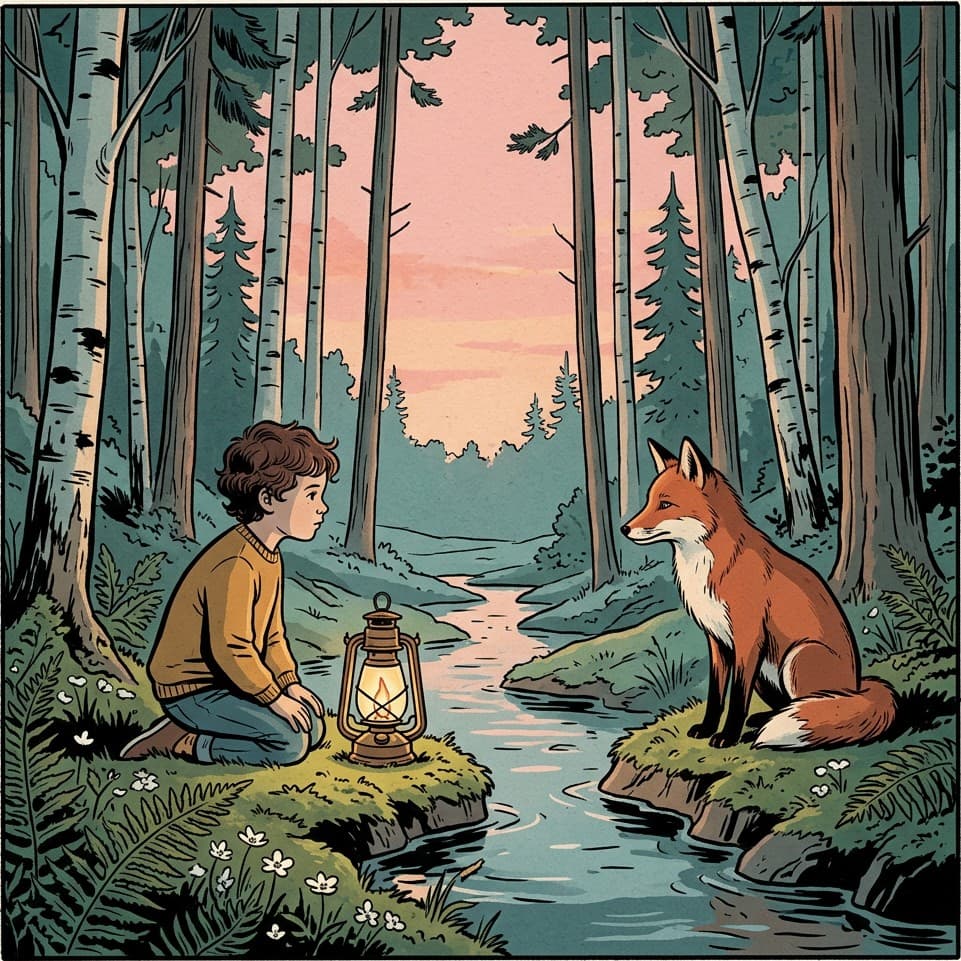
A bold ink line, strong shadows, pictures framed like a film. The style of graphic novels, for children who find classic picture books too tame.
Read the whole story for freeThe same style throughout the bookeBook £4.50
From comics to the book
Will Eisner popularised the term graphic novel in 1978 with A Contract with God. He wanted to show that a story told in pictures can also be a book for adults.
The decisive turning point came in 1992, when Art Spiegelman received a special Pulitzer Prize for Maus. From then on, the question of whether comics can be literature was as good as settled.
For children, the genre matters for another reason too. In Germany, the Stiftung Lesen, a foundation that promotes reading, points out that comics offer an easy way into reading: the picture supports the text, and beginning readers don't stumble over long paragraphs.
The names behind it
Will Eisner
A Contract with God, Baronet Books, 1978
He popularised the term graphic novel and made people accept that picture stories deserve to be taken seriously as books.
Art Spiegelman
Maus, special Pulitzer Prize, 1992
The first comic to receive a Pulitzer. After it, the question of whether the format can be literature was settled.
How do you recognise the graphic novel look?
- An ink line of widely varying thickness: heavy in shadow, fine in light.
- Big black shadows, placed like graphic shapes.
- Restrained, slightly muted colours, with a single bright accent per picture.
- Cinematic framing: seen from below, from above or over the shoulder.
- Characters with realistic proportions and understated expressions.
Which children this style suits
This style is for older children, from about six or seven, and especially for those who find classic picture books too babyish. The line is serious, the mood a little cool, and the young reader is treated as a big kid.
It suits adventures and puzzles: an expedition, a secret, a mystery to solve. The cinematic framing gives every page the tension of a film scene.
It doesn't suit children under five. For them, picture-book styles with simple shapes, such as paper collage or watercolour, are much easier to read.
Good to know
From what age does this style suit?
From about six or seven. For children under five and for bedtime reading with the very youngest, classic picture-book styles suit better.
Will my child be recognisable in this style?
Yes. The character is drawn the same way on every page. You describe the hair colour, hairstyle, glasses and favourite outfit.
Does the style stay the same throughout the book?
Yes. All 14 double pages are illustrated in the style you choose, and so are the cover and the character's portrait.
- 1.Stiftung Lesen: Kindern mit Comics das Lesen schmackhaft machen. (in German)What it confirms: Comics are seen as an easy way into reading, because the picture supports the text.
- 2.Will Eisner, A Contract with God, overview.What it confirms: Published in 1978 by Baronet Books; Eisner popularised the term graphic novel with it.
- 3.The Pulitzer Prizes: Special Awards and Citations.What it confirms: Art Spiegelman received a special Pulitzer Prize in 1992 for Maus.
The other styles
- 3D animation
- Andean textile art
- Art Nouveau
- Chinese ink
- Coloured pencil
- Cordel woodcut
- Fine pen
- Graphic and simple
- Ink and watercolour
- Ligne claire
- Minhwa world
- Nordic fairy tale
- Paper collage
- Retro gouache
- Risograph
- Silhouettes
- Tingatinga world
- Ukiyo-e inspired
- Watercolour
- Wax crayon
At a glance: all illustration styles, how it works, frequently asked questions, the book without a photo, reading the story before you buy and the AI children's book.