Illustration style
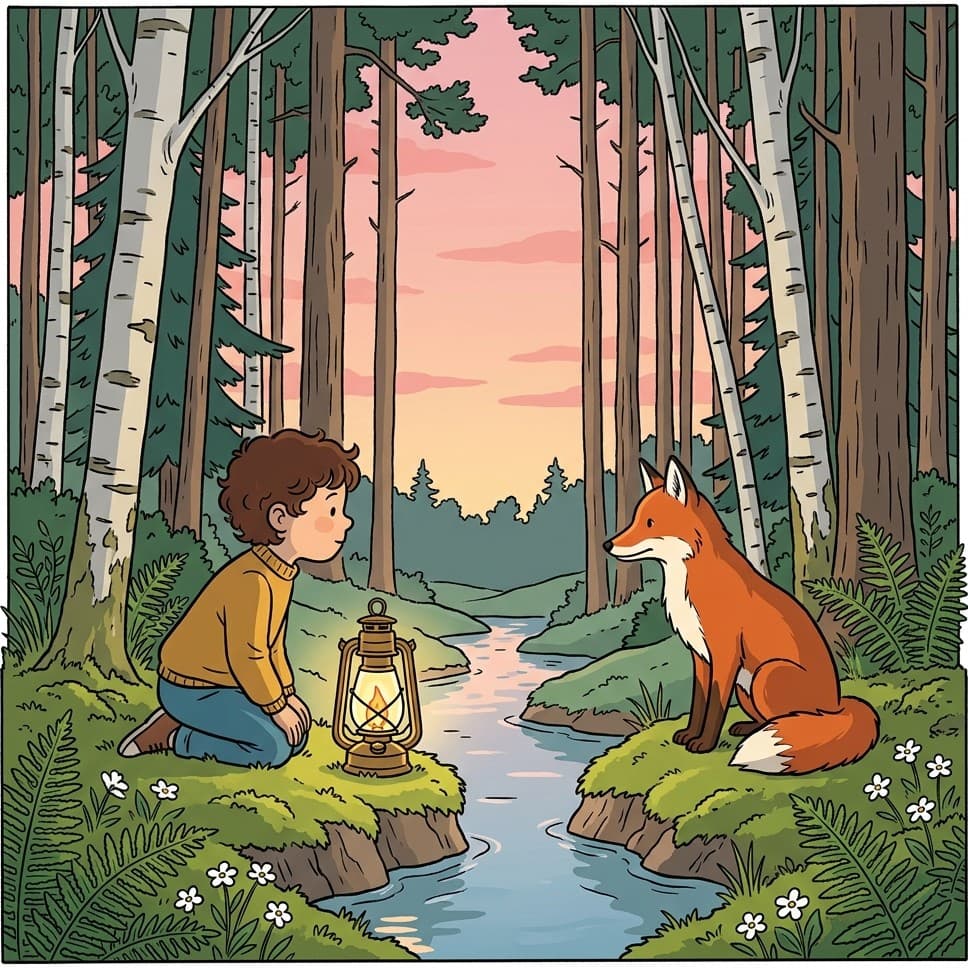
A ligne claire children's book
Outlines of even thickness, flat colour, no hatching. A style that looks simple at first glance, and for that very reason is especially hard to draw.
Read the whole story for freeThe same style throughout the bookeBook £4.50
A style older than its name
Ligne claire is the drawing style of the Franco-Belgian comics school. It was Hergé, real name Georges Remi, who shaped it from 1929 with Tintin, first in the newspaper supplement Le Petit Vingtième, then as albums from Casterman from the 1930s.
Yet the style only got its name decades later. In 1977, the Dutch cartoonist Joost Swarte coined the phrase klare lijn, which became “ligne claire” in French. Until then the thing had no name, only a school: the Brussels school around Hergé, which also included Edgar P. Jacobs and Bob de Moor.
At the same time, Swarte coined the opposite term. The atom style, named after the Atomium of the 1958 Brussels World's Fair, describes the rival school of Marcinelle around the magazine Spirou: a freer, more dynamic line with borrowings from American popular culture. Talking about ligne claire always means setting it apart from that too.
What makes this style special is a tension: characters simplified like a cartoon, in front of carefully researched settings drawn realistically. That is where the impression comes from that the story takes place somewhere real.
The names behind it
Hergé (Georges Remi)
The Adventures of Tintin, albums from Casterman, 1929
He founded the style. His even outline and flat colouring became the benchmark for a whole school, long before the style had a name.
Edgar P. Jacobs
Blake and Mortimer
A member of the Brussels school around Hergé. He showed that ligne claire also holds up for dense, text-rich adventures.
Bob de Moor
Long-time collaborator at Studio Hergé
He worked alongside Hergé for decades and helped pass the style on as a school, beyond a single person.
Joost Swarte
Coined the phrase klare lijn in 1977, 1977
Cartoonist and graphic designer. He gave the style its name, and at the same time the opposite term, atom style, which finally made the history of Franco-Belgian comics describable.
How do you recognise ligne claire?
- An outline of even thickness throughout the picture: no spot is thickened to add weight.
- No hatching. Where other styles shade with lines, the area stays solid.
- Flat, even colours without gradients.
- Few shadows, so muted contrast and a very calm overall picture.
- Simplified characters in front of detailed settings. This break is deliberate.
Which stories ligne claire suits
Ligne claire is the best choice when a story has action: adventures, journeys, investigations, everything with places and changes of scene. The style was made for stories that unfold across many pictures, and it shows: the characters stay unmistakably recognisable from page to page.
It suits calm stories carried by mood less well. What watercolour achieves through softness, ligne claire can't, because it draws every edge equally sharply.
In terms of age it suits a wide range, from about four until well into primary school. For children who already love comics, it's often the most obvious choice.
Good to know
Is ligne claire the same as comics?
It's one particular drawing style within comics. Its opposite is called the atom style and describes the freer, more dynamic school of the magazine Spirou. Both belong to comics, with a very different look.
Where does the name come from?
From the Dutch cartoonist Joost Swarte, who coined the phrase klare lijn in 1977, which became “ligne claire” in French. The style itself is almost fifty years older and goes back to Hergé, who started Tintin in 1929.
Isn't this style too plain for a children's book?
Its clarity helps reading. Because no hatching or gradient distracts, children recognise the characters and places straight away, even over many pages. For a story with action, that's a strength.
Does the style stay the same throughout the book?
Yes. All 14 double pages are illustrated in the style you choose, and so are the cover and the character's portrait.
- 1.Ligne claire, overview of the Franco-Belgian comics school.What it confirms: Hergé as founder, features of the style, link to the Brussels school.
- 2.Joost Swarte, cartoonist and graphic designer.What it confirms: Swarte coined the phrase klare lijn in 1977.
- 3.Atomstil, overview of the opposite term. (in German)What it confirms: Named after the Atomium of the 1958 World's Fair, linked to the Marcinelle school around the magazine Spirou.
- 4.The Comics Journal: The Belgians Who Changed Comics.What it confirms: The place of Hergé, Jacobs and de Moor in the Brussels school.
The other styles
- 3D animation
- Andean textile art
- Art Nouveau
- Chinese ink
- Coloured pencil
- Cordel woodcut
- Fine pen
- Graphic and simple
- Graphic novel
- Ink and watercolour
- Minhwa world
- Nordic fairy tale
- Paper collage
- Retro gouache
- Risograph
- Silhouettes
- Tingatinga world
- Ukiyo-e inspired
- Watercolour
- Wax crayon
At a glance: all illustration styles, how it works, frequently asked questions, the book without a photo, reading the story before you buy and the AI children's book.