Choosing well · Picture books
How much text per page for a children's book?
7 min read6 sources
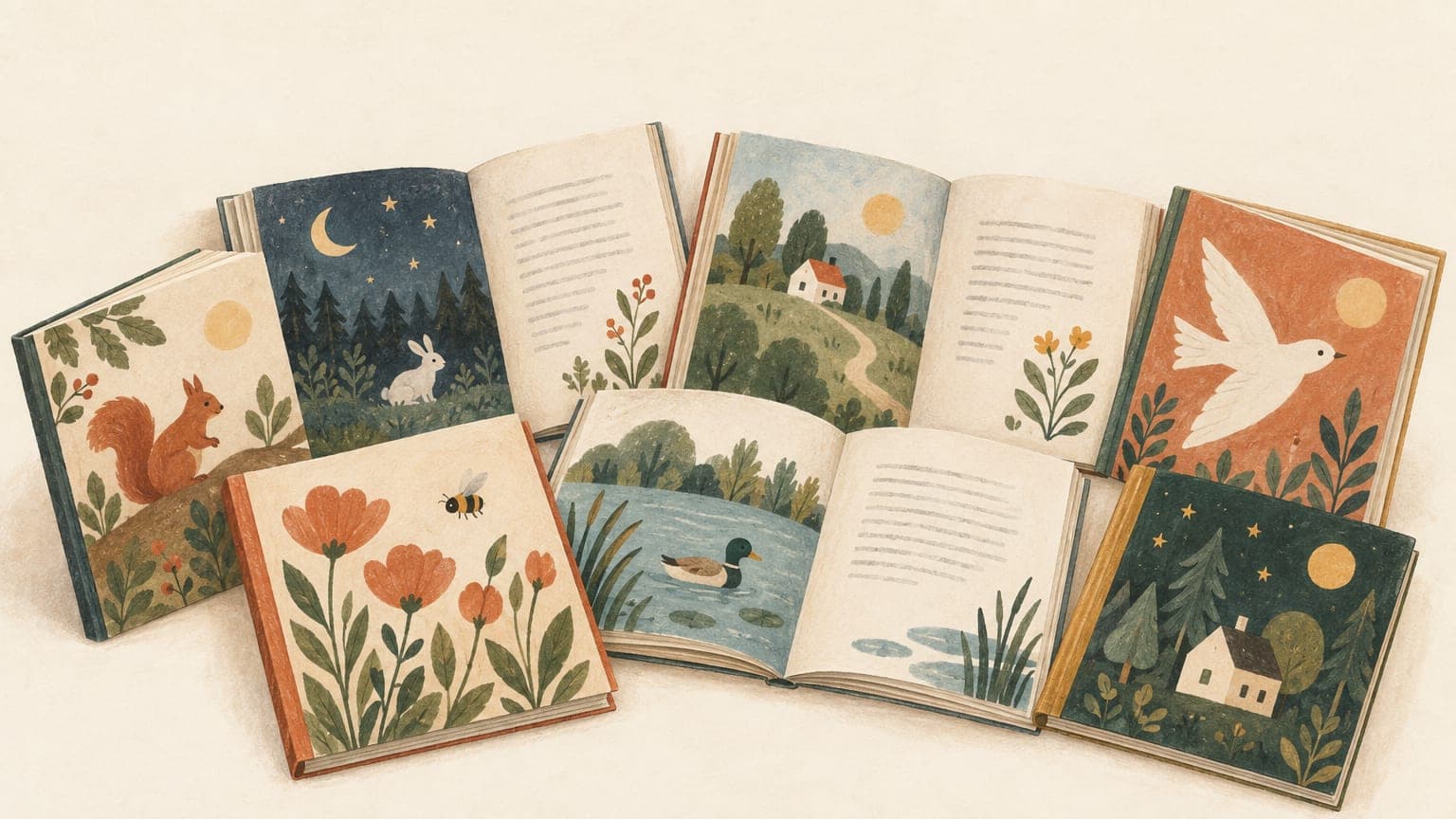
The question comes up in two places: in the bookshop, when you wonder whether a book will hold your child, and at bedtime, when everyone drifts off by the third spread. Both lead back to the same figure, and that figure is shakier than the internet suggests.
We looked for reliable guidance for this article. The result is mixed, and we present it as it is: for the amount of text, there are usable figures from publishing. For attention span, there's a famous formula behind which we found no study.
What can be established, and what remains unproven
- Publishing gives precise figures, taken from the practice of publishers. The reference guide of the Society of Children's Book Writers and Illustrators gives 500 to 750 words for a picture book for ages 3 to 8.1
- The trend is downwards. Several publishing sources describe a shift from the classic range of 500 to 600 words towards 400 to 500 words.3
- The “age × 2 minutes” rule has no identifiable source. It circulates on many parenting sites, often as a table by age band, with no named study or date.6 We looked for an original study and found none.
- Measured attention is much shorter. An observational study of first-grade pupils found about seven minutes of real attention to the task in class, compared with the roughly 18 minutes cited in the literature as “expected” at that age.5
How many words, usually?
The most solid figures come from English-language publishing. They are submission guidelines for authors, designed for publishers; they describe fairly accurately what actually gets printed.
Board book (0 to 3): up to about 100 words. First picture book (0 to 3): up to about 400 words. Picture book (3 to 7): about 500 to 600 words, up to 750 for ages 3 to 8 according to the SCBWI. Non-fiction picture book (5 to 9): 1,000 to 2,000 words, exceptionally up to 3,000.12
The SCBWI, the American association of children's authors and illustrators, gives 500 to 750 words in its own guide for a picture book for ages 3 to 8.1 If a book looks “wordy” as you flick through it, statistically you're often right.
A figure we don't repeat: you sometimes read of an 800-word ceiling for SCBWI submissions. The page where it appeared no longer exists, and no accessible SCBWI page still gives that figure. Current calls for submissions range from 1,000 to 2,000 words and contradict each other. So we give no ceiling.
How long the classics really are
A children's publishing specialist counted the words in famous titles. It isn't a study; the figures still put the guidance above into perspective:4
Goodnight Moon about 130 words · The Very Hungry Caterpillar about 220 · Where the Wild Things Are about 330 · The Polar Express more than 1,600.
Three of the four best-known picture books in the world are well below what passes for the norm. That's the real finding of this section: among books that last, brevity is the rule. The Polar Express shows at the same time that there are exceptions: a long picture book works when it carries you along.
The story of two minutes per year of age
You probably know the rule: a three-year-old can concentrate for six minutes, a five-year-old for ten. The figures vary from page to page: the one we cite as an example gives 8 to 12 minutes at four and 12 to 18 minutes at five or six. That alone should raise an eyebrow.
Tables by age band circulate on many parenting pages.6 We found no original study. The page we cite as an example gives no source for its table.
The research that does exist measures attention in other settings: in class, with standardised tests, and never during a story on the sofa. The only observational study we found arrives at about seven minutes of real attention in first-grade pupils.5
In practice: treat the formula as a rough pointer at most. If your four-year-old stays with a story for twenty minutes, there's nothing unusual about it, and if they get up after four minutes, that's fine too. Reading aloud is also not a concentration exercise in the sense of these measurements: there are pictures, closeness, a voice, and the right to interrupt.
Four checks that take ten seconds
1. Open a spread and count the sentences. For ages 2 to 4, a few short sentences per spread read easily.
2. Read it aloud in your head. If you stumble reading silently, you'll stumble aloud too, every evening.
3. Look for repetition. Refrains your child can say with you stretch their attention more than any cut.
4. Look at the picture alone. Does it tell the scene without the text? Then the book still works when your child stops listening and just looks.
For the rest, the most useful guide is also the least precise: read a little and often rather than long and rarely. Our page on reading aloud has more on that.
Frequently asked questions
How many words are in a typical picture book?
According to publishing guidance, about 500 to 600 words for ages 3 to 7; the SCBWI's reference guide gives 500 to 750 words for ages 3 to 8. The trend is towards 400 to 500 words. Board books for the youngest have up to 100 words.
Is it true that a child can concentrate for two minutes per year of age?
The rule is very widespread, but we found no original study. Tables by age circulate on many parenting pages; in the example we examined, no source is cited. It can serve as a rough pointer, but it says nothing about your own child.
My child only listens for two minutes. Is that a problem?
Usually not. An observational study found about seven minutes of real attention in class among first-grade pupils, and reading aloud is a far more open situation than a lesson. Reading a little and often does more than long sessions where everyone ends up frustrated.
How can I tell in the bookshop whether a book is too long?
Open a spread and count the sentences: for ages 2 to 4, a few short sentences read easily. And check whether the picture tells the scene without the text: then the book still works when your child is only looking.
Sources
- 1.Society of Children's Book Writers and Illustrators (SCBWI): “The Book”, 2021 edition, presented in SCBWI Kite Tales, “Ask an Editor: Word Count” (2022).What it confirms: Fiction picture book: 500 to 750 words for ages 3 to 8; about 250 words per manuscript page.
- 2.Mary Kole (editor, former literary agent): Children's Book Length Guidelines.What it confirms: Board book up to 100 words, first picture book up to 400, picture book up to 600, non-fiction picture book 1,000 to 2,000 (3,000 at most).
- 3.Writers in the Storm: “Picture Book Word Counts. Minimalism to Modern Stories” (2025).What it confirms: The shift of the usual range from 500 to 600 words towards 400 to 500 words (an industry observation, not a study).
- 4.Bookfox (John Fox): “What's the Perfect Length for a Children's Picture Book?” (2023), a personal count, not a systematic survey.What it confirms: Word counts of famous titles: Goodnight Moon about 130, The Very Hungry Caterpillar about 220, Where the Wild Things Are about 330, The Polar Express more than 1,600.
- 5.“First Grader's Attention Span During In-Class Activity” (observational study).What it confirms: About seven minutes of attention to the task observed in first-grade pupils, compared with about 18 minutes cited in the literature as the expected span.
- 6.Example of the unsourced rule: CNLD Neuropsychology, “How Long Should a Child's Attention Span Be?”, with no source for the formula.What it confirms: A table of attention spans by age (2 years: 4 to 6 minutes, 3 years: 6 to 8, 4 years: 8 to 12, 5 to 6 years: 12 to 18), with no original study cited.
A word about us
Why this question matters to us
We make personalised children's books at Sagalino, and for our own format we had to decide how much text fits on a spread. This article came out of the search for reliable figures, and the discovery that the most quoted rule on the subject has no source.
Related articles
- Gender roles in picture booksAn analysis of 3,280 books over sixty years: the gap between male and female characters is closing among humans, and stays wide among animals.
- Books for 2 year oldsSeven books rated from two, from Goodnight Moon to The Tiger Who Came to Tea, for the age when a picture becomes a sign.
- Books for 3 year oldsSeven picture books for the age of why and how, from Room on the Broom to Where the Wild Things Are, each with the age BookTrust or Common Sense Media gives.
All magazine articles
By age
The classics
Choosing well
At a glance: the illustration styles and how it works.